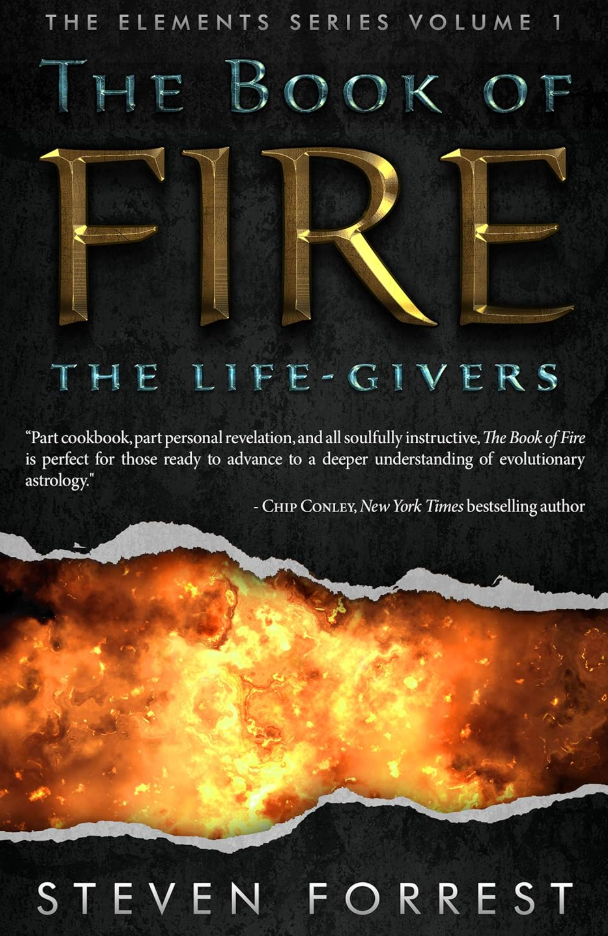
There are some astrology books that teach you techniques. There are others that help you memorise symbols. And then there are the rarer books that change the way you feel astrology from the inside.
Steven Forrest’s The Book of Fire belongs in that third category.
On the surface, it is the first volume in his Elements Series, exploring the astrological fire signs, fire planets and fire houses but that description, while accurate, does not quite capture the spirit of the book. The Book of Fire is not simply about Aries, Leo and Sagittarius. It is about life-force, courage, resilience and appetite. The human capacity to keep going, keep creating, keep risking and keep saying yes to life even after life has knocked us sideways.
For anyone following the Steven Forrest path, and particularly for those of us working through the FCEA certification programme, this book has a special place. It is not just a reference text. It is part of the deeper apprenticeship in learning how to think astrologically, psychologically and evolutionarily at the same time.
And perhaps most importantly, it reminds us of something easily forgotten in spiritual work: the soul does not evolve by becoming smaller. It evolves by becoming more alive.
Fire as Life-Force
In Steven’s elemental model, fire is not merely temperament. It is not just enthusiasm, impulsiveness or dramatic flair, although it can certainly express through all of those things. Fire is the part of us that moves toward life rather than away from it.
It is the spark that says, “I am here.”
It is the inner heat that allows a person to act, create, desire, explore and take the risk of becoming visible. Without fire, we can become too mental, too therapeutic, too cautious, too neat. We can understand our wounds, analyse our patterns, identify our karmic residue and still fail to live.
That is why The Book of Fire feels so important within an Evolutionary Astrology context. The point of the work is not simply to understand the chart. The point is to cooperate with the soul’s unfolding. That requires energy. It requires courage and it requires the willingness to participate in life rather than simply interpret it from a safe distance.
Steven frames the fire family around Aries, Leo, Sagittarius, Mars, Jupiter, the Sun, and the first, fifth and ninth houses. These are not nine separate vocabulary cards. They are nine expressions of vitality. Together, they show where the soul finds heat, momentum and the confidence to keep moving.
That framing matters. Fire is not decoration. Fire is medicine.
Its place in the FCEA curriculum
The Forrest Center for Evolutionary Astrology introduces the Elements books early in the certification pathway. They appear as supplemental texts in FCEA-101 and FCEA-102, become required texts in FCEA-103, and continue to support the craftsperson and master-level work. They are also required again in FCEA-302, FCEA-303 and FCEA-306.
That progression tells us something.
The Elements Series is not an optional decorative layer. It is part of the language of the Forrest method. It deepens the student’s ability to understand signs, planets and houses not as isolated keywords, but as living symbolic families.
A beginner might learn Aries, Mars and the first house as separate entries in a textbook. Aries is assertive. Mars is action. The first house is identity. That is useful as a starting point, but it is not yet astrology. It is vocabulary (words as Steven puts it).
Steven’s approach asks us to feel the underlying elemental current running through all three. Aries, Mars and the first house are not identical, but they are related. They each speak, in their own way, about the soul’s capacity to act, initiate, defend aliveness and meet life directly.
The same principle applies to Leo, the Sun and the fifth house. It also applies to Sagittarius, Jupiter and the ninth house. Different symbols, different levels, different functions but each carries the fire current.
This is one of the reasons the Elements books are so valuable for FCEA students. They train the astrologer to think in families of meaning rather than in disconnected fragments.
And that is where interpretation begins to mature.
From Cookbook Astrology to Living Symbolism
One of the traps in learning astrology is the temptation to collect meanings. We make lists. We underline keywords. We build mental filing cabinets. There is nothing wrong with that. In fact, it is necessary at the beginning but there comes a point where the astrologer must move beyond “this placement means that.”
The living chart does not speak in bullet points.
It speaks in patterns, tensions, invitations, defences, contradictions and potentials. A chart is not a spreadsheet of traits. It is a symbolic field.
The Book of Fire helps the student make that transition. It does not simply say, “Here is Aries, here is Leo, here is Sagittarius.” It invites us into the atmosphere of fire itself. That is a different kind of learning. It asks for imagination, empathy and embodiment.
This is where Steven’s writing is so distinctive and what drew me to the FCEA in the first place. He does not flatten symbols into definitions. He animates them. He gives them pulse and blood and mythic colour. The result is that the reader does not simply learn about fire. The reader begins to recognise fire.
In clients, in stories and in life passages. In moments of crisis, in the places where someone has lost heart and, in the places where someone is being asked to reclaim joy, courage or appetite.
For an evolutionary astrologer, that matters enormously. We are not simply describing personality. We are listening for the soul’s next step.
Sometimes that next step is fiery. Sometimes the medicine is not more analysis, but more life.
Aries, Leo and Sagittarius: Three Flames, Three Medicines
One of the great strengths of The Book of Fire is that it does not treat the fire signs as interchangeable. Aries, Leo and Sagittarius are all fire, but they are not the same fire.
Aries is the flame of emergence. It is the raw, immediate spark of instinct, courage and direct encounter. In evolutionary terms, Aries often asks: where has the person lost the right to act? Where have they become over-domesticated, over-managed or over-concerned with approval? Where does life require a clean, brave yes or no?
Leo is the flame of radiance. It asks a different question: where is the soul meant to shine? Not perform in a hollow way. Not seek applause as a substitute for self-worth. But shine from the centre. Leo’s higher expression is creative generosity – the warmth of a person who has found enough inner permission to offer something heartfelt to the world.
Sagittarius is the flame of meaning. It is the pilgrim, the seeker, the one who needs horizon, wisdom, humour and possibility. Sagittarius reminds us that the human spirit can suffocate without a sense of direction. We do not live by bread alone; we also live by story, vision and the felt sense that life is still open.
Together, these three signs form a powerful evolutionary sequence.
Aries says: begin. Leo says: create. Sagittarius says: believe.
I can see that sequence in my own life. The warrior needs Aries: the courage to take a step. The mystic needs Sagittarius: the horizon that gives the step meaning. And the heart needs Leo: the permission to live from its own centre rather than from inherited scripts.
The Fire Planets and Houses
The Sun, Mars and Jupiter are not merely technical factors. They are living functions within the psyche.
The Sun is the principle of centredness. In evolutionary astrology language, the Sun is connected with the path of becoming more fully oneself. Not the false self or the defended self and not the socially polished self. The real one.
Mars is the principle of desire and assertion. It shows how we act, pursue, defend and separate. Mars often gets reduced to anger or sexuality, but in a healing context it is also the planet of healthy self-protection. A person with a wounded Mars may struggle to want cleanly, act directly or defend their boundaries without guilt.
Jupiter is the principle of faith, aspiration and enlargement. It describes where the soul seeks more life, more meaning, more perspective. Jupiter can overreach, inflate or exaggerate, but its higher purpose is not greed. It is trust. It is the part of us that senses that life might be bigger than our fear.
The first, fifth and ninth houses complete the fire family. The first house says, “I enter.” The fifth says, “I create.” The ninth says, “I seek.” In a client reading, that distinction is invaluable. If someone has lost connection with their first house, they may need courage. If they have lost connection with their fifth house, they may need joy. If they have lost connection with their ninth house, they may need meaning.
Those are not the same remedies. Good astrology knows the difference.
Fire and the Mystic Warrior Path
The Book of Fire means a lot to me, because I spent a career in uniform.
The word “warrior” can easily be misunderstood. It is not about aggression, domination or spiritual machismo. The inner warrior is the part of us willing to meet life consciously. It is the part that chooses rather than drifts. It acts without needing certainty. It protects what you love: your kids, your time, your values. It says yes when the soul says yes, and no when the soul says no.
That is fire.
But Mystic Warrior Astrology also includes the mystic. Fire without the mystic can become ego, noise, impulse or conquest. The mystic reminds fire that courage must serve meaning, what you want has to fit what you care about and action must be guided by wisdom.
This is why Steven’s treatment of fire is so useful. He does not present fire as mere self-assertion. He presents it as the thing that gets you out of bed. Properly understood, fire is not selfishness it is vitality and the refusal to let the soul go dim.
On the FCEA course, this is one of the lessons that keeps returning. Evolutionary Astrology can take us into deep waters: old wounds, karmic residues, family patterns, unconscious scripts, grief, fear and shadow. That work matters. But if we are not careful, we can start to confuse depth with heaviness.
Fire corrects that. It reminds us that healing is not only about processing pain. It is also about recovering the capacity to dance.
Mystic Warrior Summary
Difficulty: ★★★☆☆
Best suited for: Students who know the basics and want to deepen vitality, courage and symbolic fire.
FCEA Path: Required across key FCEA stages including FCEA-103, FCEA-302, FCEA-303 and FCEA-306.
Neil’s Rating: ★★★★★
Key Themes: Fire, vitality, courage, desire, creativity, meaning, resilience.
Why I Keep Returning to This Book
I keep returning to The Book of Fire because it corrects the tendency to make Evolutionary Astrology too heavy. It reminds me that soul work is not only about wounds, karmic residue and unconscious patterning. It is also about recovering heat, joy, appetite and the courage to live. For me, that is invaluable. The mystic listens, but the warrior acts. Fire is where that action begins.
Final Reflections
The Book of Fire is a fitting beginning to the Elements Series because fire itself is a beginning.
Before we can build, relate, heal, analyse or let go, something in us must first say yes to life. That yes may be loud or quiet. It may come as a brave decision, a creative act, a recovered dream or a single step taken after a long season of fear.
But without that yes, the chart remains theoretical.
Evolutionary Astrology is not fatalistic. It does not say, “This is your chart, therefore this is your prison.” It says, “This is your chart, and here are the energies asking to be lived more consciously.”
Fire is one of the great teachers of that truth.
It reminds us that the soul did not come here merely to survive its history. It came to participate in life, to risk, to create, to seek, to shine and to become warm again.
For anyone walking the Steven Forrest path, The Book of Fire is therefore much more than a book about an element. It is a call back to vitality. And perhaps that is why it belongs so firmly at the start of the FCEA course, in modules 101 to 103.
Where’s the fire in your chart? Look for your Sun, Mars and Jupiter and see what lights up.
Related in this series
- The Book of Earth — embodiment, craft and making the soul real.
- The Book of Air — perception, language and paying attention.
- The Book of Water — feeling, memory and healing.
- The Elements Series — how Fire, Earth, Air & Water work as a set.
This review is part of my complete Steven Forrest reading guide — or explore the wider Evolutionary Astrology Books.