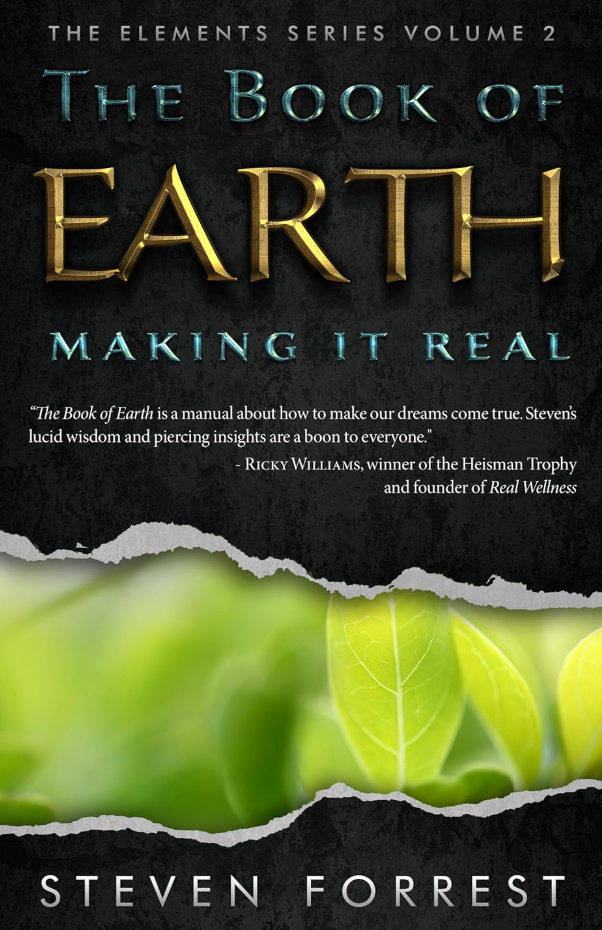
If The Book of Fire begins the Elements Series with vitality, courage and appetite, The Book of Earth asks a quieter but equally important question: what are you going to do with the spark?
This is where Steven Forrest’s second volume in the Elements Series becomes so valuable. The Book of Earth is not simply about Taurus, Virgo and Capricorn. It is about incarnation. It is about the difficult, beautiful work of turning possibility into biography.
Fire says yes, Earth says prove it.
Not in a harsh or cynical way, Earth is not anti-dream. In Steven’s hands, earth becomes the bridge between vision and reality: the diary, the budget, the first draft. It asks whether our values, habits, bodies, resources, skills and responsibilities are strong enough to carry what the soul says it wants.
That makes The Book of Earth essential reading for anyone who wants astrology to be more than inspiration. It is a book for the moment after the insight, when the real question becomes: how do I live this?
For us students on the Steven Forrest path, and especially those working through the FCEA certification programme, this is not a secondary concern. It is central. The FCEA course doesn’t just ask us to understand symbols. It asks us to become practising astrologers with discipline, judgement, humility and craft. Earth teaches those virtues.
Earth gets things done
The earth element is often misrepresented as dull, conservative or materialistic. That is understandable, but it is also a serious misunderstanding.
In evolutionary terms, earth is not the enemy of spirit, it is the field in which spirit becomes visible.
A dream without earth may remain a beautiful mist, a calling without earth may remain a private fantasy, and a healing insight without earth may comfort us for an evening but fail to alter the way we live on Monday morning.
Earth asks for embodiment, it asks for practice, it asks for evidence, and it asks us to honour time, limits, consequences and the wisdom of the body.
Steven’s treatment of earth corrects a lot of lazy stereotypes. He shows that Taurus, Virgo and Capricorn are not simply signs of money, work and ambition. They are three different pathways into making life real. Taurus asks us to root into value and simplicity, Virgo asks us to refine, practice and serve, while Capricorn asks us to take responsibility for the mountain we are actually climbing.
That is why The Book of Earth is so important within Mystic Warrior Astrology. The mystic can receive the vision, but the warrior must build the road.
Its Place in the FCEA Curriculum
The FCEA catalogue places the four Elements books near the beginning of the learning path. They appear as supplemental texts in FCEA-101 and FCEA-102, become required in FCEA-103, and continue to support the 200-level and 300-level studies. The Book of Earth is also specifically required in FCEA-302, FCEA-303 and FCEA-306.
This curriculum placement makes sense. Earth is foundational not because it is simple, but because it trains the astrologer in realism.
In FCEA-101, students begin learning the basic language of signs, houses, planets and aspects. The Book of Earth helps ensure that Taurus, Virgo, Capricorn, Venus, Mercury, Saturn, and the second, sixth and tenth houses are not reduced to stereotypes. In FCEA-103, where chart reading becomes more practical, earth becomes even more important as we learn to translate symbolic understanding into something that can actually help another human being.
Later, in the 200-level work on transits, progressions, solar arcs and relationships, earth becomes the question of timing and consequence. What is ready to be built? What needs repair? What pattern has become embodied? What practical step would honour the soul rather than simply flatter the ego?
By FCEA-306, the Master Chart Reading Practicum, the Elements Series comes back into full relevance. A chart reading must be more than inspired language. It must be useful, grounded and ethically sound. Earth keeps the astrologer honest.
Taurus: The Ground of Value
Taurus is the first earth sign, and it teaches the sacredness of simple existence. It is easy to mistake Taurus for comfort-seeking or stubbornness, at its higher-level Taurus asks a big question: what is truly worth building a life around?
Taurus brings us back to the body, the senses, the earth beneath the feet and the value system beneath the choices. When Taurus is healthy, there is steadiness, there is patience and there is a capacity to receive life rather than chase it. There is an instinct for what nourishes and what depletes.
In a client reading, Taurus often asks us to explore security and self-worth. Where has the person learned to distrust their own value? Where have they substituted accumulation for peace? Where are they being invited to slow down enough to hear the wisdom of the body?
The evolutionary remedy is rarely glamorous. Taurus doesn’t always need a dramatic life change. Sometimes it needs the right breakfast, a walk, a clear financial boundary, a garden, a rhythm, or a return to what is real.
That may sound modest, but it is not. Many souls cannot evolve because the nervous system has no ground. Taurus teaches that healing often begins with stability.
Virgo: The Path of Practice
Virgo is earth in motion. It is the sign of refinement, skill, adjustment and service. Where Taurus roots, Virgo improves.
Virgo is often caricatured as critical or perfectionistic. Those can be some of the shadow expressions, but it misses the point of the sign. Virgo’s deeper purpose is apprenticeship. It knows that meaningful development requires humility. We get better by paying attention and improve by serving the work rather than protecting the ego.
This is particularly relevant for us FCEA students. Astrology is not mastered through inspiration alone. It requires practice. It requires the willingness to be wrong, to refine our language, to listen to feedback, to distinguish what the chart says from what we would like it to say.
Virgo teaches that good interpretation is not self-expression, it is service.
That can be a hard lesson for astrologers, especially when we are excited by symbols and eager to speak. Virgo asks us to slow down and test our craft. Is this interpretation precise? Is it useful? Is it humble? Does it serve the client or simply display the astrologer’s cleverness?
For me, this is a crucial safeguard. The mystic listens. The warrior chooses. Virgo adds: and then the craftsperson practises until the work is sound.
Capricorn: The Mountain of Responsibility
Capricorn completes the earth triad by introducing the question of structure, maturity and consequence. It is the sign of the mountain: the long climb, the apprenticeship, and authority earned through effort.
Again, the stereotype is too small. Capricorn is not merely ambition or hard work. It’s the discipline of getting good at something.
In evolutionary work, Capricorn often asks where the soul must stop outsourcing authority. It may describe old burdens, inherited expectations or fear of failure. But it may also point toward the dignity of competence. Capricorn wants the person to stand upright in their own life.
For us as FCEA students, Capricorn has obvious relevance. Certification is not a badge handed out for enthusiasm. It is a path of earned capacity. We gradually learn to hold more complexity, more responsibility and more ethical weight.
A chart reading is not a performance. It’s a responsibility: someone is trusting you with their life story. Capricorn understands that.
When working with clients, Capricorn symbols often reveal where a person is being asked to build a stronger container. That may mean career direction, boundaries, commitments, elderhood, professional identity or emotional maturity. The point is not worldly success for its own sake. The point is a job and a life that fit who you are.
Earth reminds us that the soul does not only need freedom, it also needs structure sturdy enough to hold freedom.
The Earth Planets and Houses
Steven’s earth family includes Venus, Mercury and Saturn, along with the second, sixth and tenth houses. This is a beautifully practical grouping.
Venus, in this context, is not only romance. It is value, beauty, worth, embodiment and the felt sense of what matters. Mercury becomes the craft of discrimination: the capacity to notice, name, organise and communicate. Saturn becomes the teacher of time, consequence and mastery.
Together, these planets move earth beyond “materialism” and into the territory of conscious living.
The second house asks: what sustains me? What do I value? What resources, inner and outer, can I rely upon?
The sixth house asks: what needs practice, service, repair or refinement? What habits are either supporting or undermining the soul’s intention?
The tenth house asks: what am I building in the world? What responsibility is mine to accept? What form of authority am I ready to embody?
In an actual reading, these distinctions matter. A second-house issue may require stabilisation and self-worth. A sixth-house issue may require habits, skills and honest adjustment. A tenth-house issue may require public responsibility and mature direction.
Earth is practical, but it is not simplistic.
Earth Shadow: When Reality Becomes a Prison
No element is automatically healthy. Earth can ground the soul, but it can also trap it.
Distorted earth may become fear, rigidity, overwork, material obsession, perfectionism, judgement or lifeless duty. It may mistake safety for aliveness. It may cling to the known long after the soul has outgrown it. It may measure worth only by productivity, status or usefulness.
In the consulting room, this is of central importance. A client with strong earth may appear capable while privately exhausted. They may have built a life that works on paper but no longer feeds the soul, or they may be loyal to duties that have become dead forms.
The evolutionary answer is not to reject earth but to redeem it.
Taurus must learn living value rather than mere possession. Virgo must learn devotion rather than self-attack. Capricorn must learn integrity rather than fear-based control.
Earth at its best does not suppress the soul, it gives the soul a body, and a rhythm and place to stand.
A Personal Reflection from the FCEA Path
In my own FCEA journey, The Book of Earth feels like a necessary antidote to spiritual vagueness.
Evolutionary Astrology can open huge landscapes: karma, soul memory, purpose, transits, initiation, shadow and healing. It is easy to become inspired by the grand pattern, but earth asks the inconvenient question: what does this mean in a Tuesday afternoon life?
That question matters.
If astrology cannot help a client make wiser choices, honour their body, set a boundary, improve a pattern, take responsibility or recognise what is truly worth their energy, then something is missing. The reading may be beautiful, but it may not be grounded.
Earth helps prevent that. It keeps the work honest, practical and humane.
In my work, this is essential. I want a reading to help with real life: a boundary, a habit, a decision you’ve been putting off. I want it to be a reflective practice that helps people live with more awareness, courage and integrity. The Book of Earth supports exactly that kind of astrology.
Mystic Warrior Summary
Difficulty: ★★★☆☆
Best suited for: Students and practitioners who want to ground interpretation in embodiment, craft and real life.
FCEA Path: Required in the elemental sequence and central to FCEA-103, FCEA-302, FCEA-303 and FCEA-306.
Neil’s Rating: ★★★★★
Key Themes: Earth, embodiment, practice, maturity, craft, material life, integration.
Why I Keep Returning to This Book
I keep returning to The Book of Earth because it brings astrology back into the body. It is easy to speak beautifully about the soul while neglecting the practical life in which that soul has to live. Earth reminds me that healing must become embodied: in work, health, discipline, money, routines, limits and the daily acts that make change real.
Final Reflections
The Book of Earth is a book about manifestation, but not in the shallow sense. It is not about wishing harder or using astrology to force life into compliance with the ego’s desires.
It is about making the soul real.
That means values, choices, habits, skills, work, responsibility, embodiment and time. It means honouring the fact that we are not disembodied spirits floating through symbolism. We are human beings living in bodies, relationships, jobs, homes, schedules and consequences.
Earth says that this is not a spiritual inconvenience. It is the path.
For us FCEA students, The Book of Earth is therefore foundational. It teaches the craftsperson’s humility, the practitioner’s discipline and the client’s need for language that can be lived. It reminds us that interpretation must eventually touch the ground.
What’s one practical thing the earth in your chart could help you build this year? I’d love to know.
Related in this series
- The Book of Fire — vitality, courage and life-force.
- The Book of Air — perception, language and paying attention.
- The Book of Water — feeling, memory and healing.
- The Elements Series — how Fire, Earth, Air & Water work as a set.
This review is part of my complete Steven Forrest reading guide — or explore the wider Evolutionary Astrology Books.