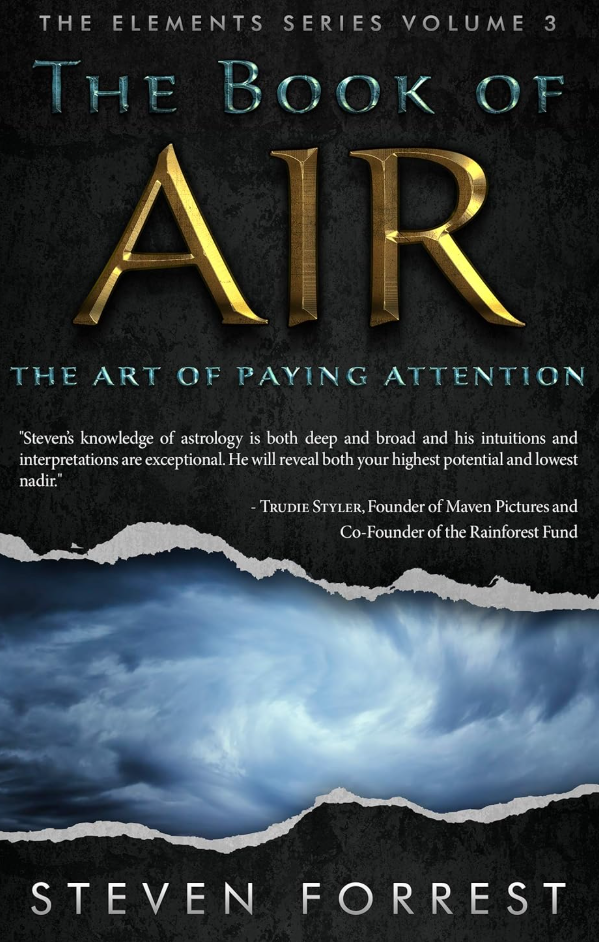
If fire gives us vitality and earth gives us embodiment, air gives us perspective.
Steven Forrest’s The Book of Air, the third volume in his Elements Series, is an extended meditation on one of the most underestimated spiritual disciplines in astrology: paying attention.
That may sound simple but it is not.
To pay attention is to allow reality to interrupt our assumptions, to listen before we interpret and to become porous to information, relationship, context and truth. In astrology, air is often reduced to intellect, social life or communication. But in Steven’s hands, air becomes something far more subtle: the connecting tissue between mind, world and meaning.
The Book of Air explores Gemini, Libra and Aquarius, along with Mercury, Venus, Uranus, and the third, seventh and eleventh houses. These nine symbols form the air family. They teach us how we perceive, connect, speak, listen, compare, collaborate and imagine a wider human field.
For us students on the FCEA path, this is not merely an intellectual topic. It is a professional necessity. I’ve learned that the listening matters as much as the chart. An astrologer who cannot communicate with care will not serve a client well and an astrologer who cannot update their perception will end up projecting old assumptions onto living people.
Air is the element that reminds us: astrology is not only what we know, but also how we pay attention.
Air as Connection
Air is the element of relationship through information; it is the conversation between self and world.
A breath enters and leaves the body, a word travels from one person to another, and an idea moves through a room and changes the atmosphere. A chart symbol meets a client’s story and suddenly becomes alive.
This is air.
In ordinary astrology, air signs are often described as mental, social or detached. There is truth in that, but it is incomplete. Air is not only thought, but also contact and the capacity to notice patterns, exchange meaning, create language and build bridges.
Without air, astrology can become solipsistic. We might feel deeply, act passionately, or build responsibly, but still fail to understand one another. Air opens the window. It asks us to test our private story against reality.
This makes The Book of Air essential reading for anyone who reads charts for other people. We are not here to impose a reading on the client. We are here to enter a field of shared meaning. That requires listening, dialogue, humility and the ability to revise what we thought we knew.
Its Place in the FCEA Curriculum
Like the other Elements books, The Book of Air appears early in the FCEA curriculum. The Elements Series is listed as supplemental reading in FCEA-101 and FCEA-102, required in FCEA-103, and then carried through the 200-level work. It also remains required in key 300-level courses, including FCEA-302, FCEA-303 and FCEA-306.
The Book of Air has an additional significance: it is also listed as a required text in FCEA-304, the Invisible Planets course on Uranus, Neptune and Pluto. That makes sense, because air’s connection with Uranus, Aquarius and the eleventh house helps students approach the transpersonal mind, collective patterns and the shocks that make you see things differently: a redundancy, a diagnosis.
At the apprentice level, Air helps students form sentences out of symbols. At the craftsperson level, it helps them track movement, relationship and timing and at the master level, it becomes indispensable for practicum work: the astrologer must speak clearly, listen carefully, and hold multiple perspectives without losing the thread.
In other words, Air trains the astrologer in consciousness itself.
Gemini: Curiosity and the Living Question
Gemini is the first air sign, and it teaches curiosity.
This may sound light, but curiosity is spiritually powerful. A curious person has not closed the file or reduced the other person to a label. Fundamentally, they have not mistaken their first impression for the whole truth.
Gemini asks: what else is here? What am I missing? What does this symbol say when I let it speak in more than one voice?
In chart work, Gemini is essential because interpretation is an act of inquiry. A good astrologer does not simply announce conclusions. They ask better questions, they track nuance, and they allow the chart to remain alive.
Gemini also reminds us that language matters. Words can open a client or shut them down, they can invite reflection or create shame, and they can build a bridge or become a wall.
For FCEA students, Gemini is the apprentice mind: the willingness to learn, gather, compare, test and stay awake. The danger is scattering but the gift is flexibility. When Gemini is working well, the astrologer stays alert rather than rigid.
Libra: The Mirror of Relationship
Libra is air in the field of encounter. It is the sign of mirror, dialogue, balance and relational intelligence.
Libra is often reduced to harmony or people-pleasing, but its deeper purpose is far more demanding. Libra asks us to understand the other as real. Not as an extension of our needs or a projection screen and not as a threat to our autonomy. A real other.
In astrology, that is crucial. Every reading is relational. Even if the astrologer has technical skill, the reading will fail if the human exchange is poor. Libra teaches tact, proportion and the art of meeting someone where they are without abandoning truth.
This is not about diluting the interpretation. It is about ethical delivery. A true thing said badly may not serve. A difficult thing said with grace can become a turning point.
For me, Libra has a quiet but vital role. The warrior can speak truth. The mystic can sense meaning but Libra asks whether the truth has been offered in a way the other person can actually receive.
Aquarius: The Larger Mind
Aquarius completes the air triad by widening the lens.
If Gemini asks questions and Libra enters dialogue, Aquarius steps back to see the pattern. It is the sign of the group, the future, the outsider, the mind that’s just seen through something and the larger human field.
Aquarius can be cool, rebellious or abstract in its shadow expression. But at its best, it offers liberation from inherited assumptions, it asks whether the tribe’s rules are still serving life, and it sees systems, networks and possibilities beyond the obvious.
This is why Aquarius and Uranus become so important in advanced astrology. They disrupt stale perception, they break the trance, and they ask the client to see themselves from a wider angle.
In the FCEA path, this becomes especially relevant in FCEA-304, where we study Uranus, Neptune and Pluto. Uranus work demands air: the capacity to recognise the pattern, tolerate the shock of new awareness, and avoid collapsing into either rebellion or conformity.
Aquarius reminds the astrologer that sometimes healing requires a revolution in perception.
The Air Planets and Houses
Steven’s air family includes Mercury, Venus and Uranus, along with the third, seventh and eleventh houses.
Mercury is the messenger, the interpreter, the nervous system of symbolic thought. It allows us to observe, name, translate and exchange meaning. In a chart reading, Mercury is everywhere, because the astrologer is constantly converting symbol into language.
Venus in the air family is not only pleasure or romance. She is relational intelligence, the aesthetic sense, the capacity to attract, compare and harmonise. In air, Venus helps us sense what is appropriate in the space between people.
Uranus is the alarm clock! It is the lightning bolt that liberates awareness from stale consensus. Uranus breaks open the mind, not always comfortably, but often necessarily.
The third house speaks of everyday perception, learning, language and local environment. The seventh house speaks of encounter, projection, partnership and mirror. The eleventh house speaks of community, future, networks and the larger field of belonging.
Together, these symbols teach us that the mind is not isolated. We think in relationship. We become conscious through contact.
Air Shadow: When the Mind Floats Away
Air’s gifts can distort.
Unintegrated air may become detachment, overthinking, cleverness without compassion, analysis without embodiment or social performance without true contact. It can talk about feelings rather than feel them. It can discuss purpose without living it, and it can use intellectual brilliance to avoid vulnerability.
In astrology, air shadow can show up as technical arrogance. The astrologer knows the system but does not hear the person. The interpretation becomes impressive but not intimate or the chart is treated as an object rather than a living dialogue.
The remedy is not to reject air but rather to humanize it.
Gemini needs curiosity rather than scattering. Libra needs a real conversation instead of approval, and Aquarius needs a fresh angle rather than superiority or exile.
At its best, air is not cold. It is clear. And clarity, when joined with compassion, is one of the great gifts a reading can offer.
A Personal Reflection from the FCEA Path
In my own FCEA apprenticeship, The Book of Air feels like a reminder to keep listening.
The more astrology one studies, the easier it is to become confident. Confidence is necessary, but it can also become dangerous if it hardens into certainty. A chart may show archetypal patterns, but the client brings the biography. The astrologer must hold both.
Air helps with that. It keeps the work conversational, responsive and alive.
This matters especially for the kind of astrology I want Mystic Warrior Astrology to represent. Not fortune-telling or fatalism. Not clever symbolism for its own sake, but rather reflective counsel – a space where a person can hear their life more clearly and respond more consciously.
That kind of astrology needs air, it needs clean language, and it needs perspective. It needs the willingness to ask, “Is this truly what is happening, or am I projecting?”
The Book of Air supports that discipline beautifully.
Why Clients Need Air
Clients often come to astrology when their story has become too tight.
They may be trapped in one interpretation of themselves. They may think they are failing when they are actually changing or they may believe a relationship problem is purely personal when it is also archetypal. They may be living inside a family narrative, cultural script or old defence mechanism without seeing it.
Air creates space.
It allows the person to step back, breathe and see the pattern. It gives language to experience. It helps separate the self from the story enough for choice to become possible.
That is one of astrology’s greatest gifts. It does not remove the problem, but it can reframe it. A transit becomes initiation. A natal tension becomes a lifelong creative task. A relational conflict becomes a mirror. A repeated pattern becomes intelligible.
When the client can see differently, they can respond differently.
That is air medicine.
Mystic Warrior Summary
Difficulty: ★★★☆☆
Best suited for: Students developing language, perspective and interpretive clarity.
FCEA Path: Required throughout the Elements sequence and especially relevant to FCEA-304 through its link with Uranus and the invisible planets.
Neil’s Rating: ★★★★★
Key Themes: Air, perception, language, perspective, intelligence, objectivity, liberation.
Why I Keep Returning to This Book
I keep returning to The Book of Air because astrology lives or dies by language. A brilliant insight can fail if it is expressed carelessly. Air teaches the astrologer to step back, see patterns, name them clearly and preserve enough objectivity that the client can breathe.
Final Reflections
The Book of Air is about much more than mental signs. It is about attention as a spiritual practice.
To pay attention is to respect reality. To listen is to honour the soul and to speak carefully is to recognise that words carry power. To change our mind when new information appears is a sign of maturity, not weakness.
For FCEA students, these lessons are foundational. Astrology requires knowledge, but knowledge alone is not enough. The astrologer must learn to perceive, relate, translate and communicate. They must become a bridge between symbol and life.
Air is that bridge.
Fire teaches us to live. Earth teaches us to embody. Air teaches us to notice, connect and understand.
In the Mystic Warrior frame, The Book of Air belongs to the space between the mystic and the warrior: the breath before the choice, the listening before the action, and the perspective that keeps courage from becoming mere impulse.
It is a book about the mind, yes. But it’s a book about checking your story against the facts.
When did someone last really listen to you? That’s what I want a reading to feel like, and this book helped me get better at it.
Related in this series
- The Book of Fire — vitality, courage and life-force.
- The Book of Earth — embodiment, craft and making the soul real.
- The Book of Water — feeling, memory and healing.
- The Elements Series — how Fire, Earth, Air & Water work as a set.
This review is part of my complete Steven Forrest reading guide — or explore the wider Evolutionary Astrology Books.