There are some planets that are difficult because they confront us. There are others that are difficult because they dissolve us.
Neptune belongs to the second group.
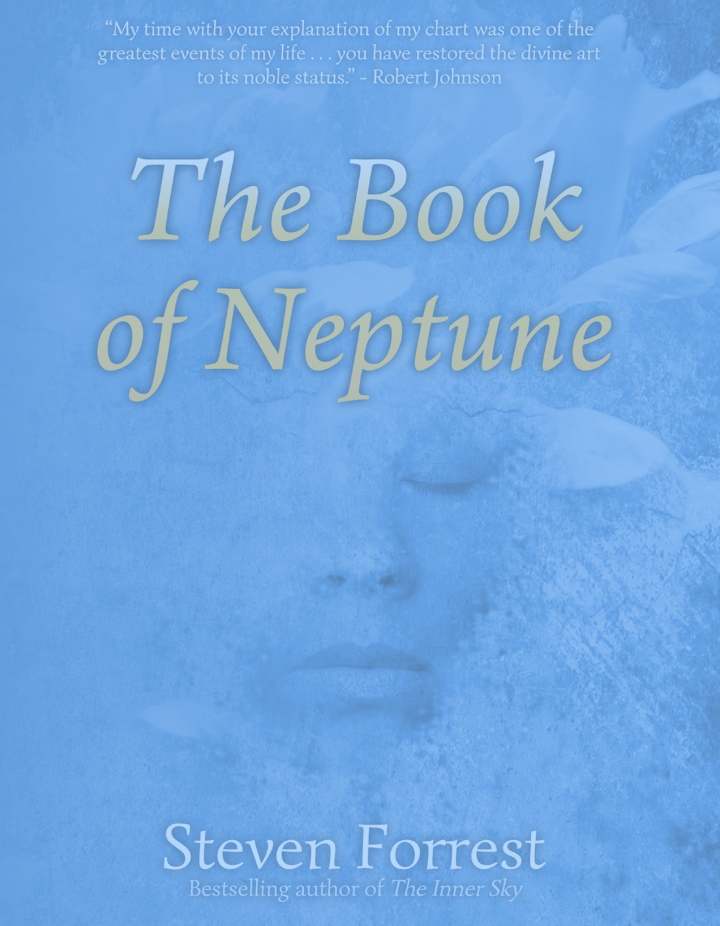
Steven Forrest’s The Book of Neptune is a guide to one of the most mysterious and spiritually charged dimensions of astrology. It is not only a book about a planet. It is a book about longing, imagination, inspiration, surrender, illusion, addiction, mysticism and the delicate art of telling the difference between grace and fog.
Steven presents Neptune as a threshold. It marks the edge between the familiar planetary world and the vastness beyond ordinary consciousness. That makes it beautiful, but also dangerous. Neptune opens the door to higher states, compassion, art and spiritual permeability. It can also seduce us into fantasy, avoidance, glamour, confusion and escape.
For anyone on the Steven Forrest path, The Book of Neptune becomes especially important when the FCEA curriculum reaches the outer planets. After the foundational work of signs, houses, planets, nodal analysis, timing and relationships, Neptune asks the astrologer to work with subtler material: the soul’s hunger for the divine and the traps that appear along the way.
In Mystic Warrior language, Neptune belongs strongly to the mystic. But the warrior is needed too, because spiritual openness without discernment can become a very beautiful way of getting lost.
Neptune as the Spiritual Imagination
Neptune is often described as the planet of dreams, spirituality, compassion, music, poetry and illusion. All of that is true, but the list can become too vague if we are not careful.
At its heart, Neptune symbolises the part of us that senses there is more to life than the visible world. It is the ache for union. The longing for grace. The part of the psyche that can be moved by beauty, prayer, silence, music, film, ocean, myth or the suffering of another being.
Neptune softens boundaries. That is its gift and its risk.
When Neptune is working well, the ego becomes transparent enough for inspiration, compassion and spiritual perspective to enter. We become less defended. Less literal. More able to forgive. More able to imagine. More able to feel that life is sacred.
When Neptune is distorted, the same boundary-softening becomes confusion. We lose the line between intuition and wishful thinking. We call avoidance surrender. We call fantasy vision. We call enabling compassion. We call addiction relief.
The Book of Neptune is valuable because Steven does not reduce Neptune to either bliss or disaster. He understands both. He treats the planet as a spiritual teacher whose gifts must be approached with humility and discernment.
Its Place in the FCEA Curriculum
The FCEA catalogue introduces The Book of Neptune as a required text in FCEA-304, Invisible Planets: Uranus, Neptune and Pluto. That course investigates the three transpersonal planets in the natal chart and as moving factors by transit, progression and solar arc.
This placement is telling.
Neptune is not part of the early apprentice-level foundation in the same way as the Elements Series. It arrives after the student has developed core interpretive language, nodal method, timing tools, relational work and substantial practice. That is appropriate because Neptune requires subtle judgement.
A beginning astrologer may be tempted to make Neptune too simple: spiritual, confused, artistic, escapist. An advanced student must learn to hold paradox. Neptune can be the saint and the addict, the visionary and the deceived, the mystic and the victim, the artist and the fugitive.
FCEA-304 asks students to recognise Neptune not only as a natal signature, but also as a moving initiatory force. A Neptune transit or progression can open tremendous spiritual and creative possibilities, but it can also coincide with disorientation. The astrologer must learn to name the invitation without pretending the fog is not real.
The Neptune Question: What Are You Surrendering To?
One of the central questions Neptune raises is surrender.
But surrender to what?
This is where the work becomes serious. Surrender to love, truth, compassion, imagination or divine mystery can be liberating. Surrender to fantasy, dependency, addiction, deception or helplessness can be destructive.
The chart does not answer that question mechanically. It reveals the terrain. The person must participate consciously.
This is deeply aligned with Steven’s free-will approach to astrology. Neptune does not force one outcome; it symbolises a field of possibility. The same placement can be lived as inspiration or avoidance, devotion or delusion, subtle perception or psychic static.
The astrologer must therefore avoid both cynicism and naivety. If we are too cynical, we flatten Neptune and rob the client of spiritual possibility. If we are too naive, we collude with confusion.
The Book of Neptune helps the reader stand in that middle place: open-hearted but awake.
Neptune in the Natal Chart
In the natal chart, Neptune shows where the soul is porous to the infinite.
By sign, it describes a generational spiritual atmosphere. By house, it shows an area of life where the person may experience both enchantment and confusion. By aspect, it shows the personal functions that may be elevated, sensitised, dissolved or tempted into fantasy.
A strong Neptune does not automatically make someone spiritual. It may make them sensitive, imaginative or permeable. But sensitivity is not the same as wisdom. The person must learn how to work with what comes through them.
For example, Neptune connected with Mercury may bring poetic perception, symbolic thought and intuitive communication. It may also bring mental fog or difficulty separating fact from fantasy. Neptune with Venus may bring romantic idealism, artistic grace and compassion in love. It may also bring projection, disappointment or saviour-victim patterns. Neptune with Mars may spiritualise action, but it may also blur desire and weaken direct assertion.
The power of Forrest’s approach is that he keeps returning the symbol to choice. The chart shows the mythic weather. It does not remove responsibility.
That is essential in spiritual astrology. Without responsibility, Neptune becomes an excuse. With responsibility, Neptune becomes a path.
Neptune by Transit
Neptune as a moving factor can be one of the most difficult experiences to describe because it often does not announce itself with clear external events. Instead, it changes the atmosphere.
Certainties fade. Old ambitions lose their charge. Boundaries soften. A person may feel tired, inspired, disoriented, spiritually hungry, artistically alive or strangely unmoored. The old map may no longer work, but the new one has not yet appeared.
This is where an astrologer needs great care. It is not helpful to tell someone in a Neptune period simply to “trust the universe” if they also need practical grounding. Nor is it helpful to pathologise the experience and treat all uncertainty as failure.
Neptune transits often require a different kind of intelligence. They ask for patience, symbolic listening, spiritual hygiene, creative practice and honest discernment. They may ask the person to release a false dream so that a truer one can emerge.
In FCEA-304, working with Neptune as a moving planet helps train the astrologer to read subtle timing without forcing clarity prematurely. Sometimes the correct counsel is not “act now.” Sometimes it is “listen more deeply, simplify, stay sober, keep boundaries clean, and allow the false image to dissolve.”
That is Neptune wisdom.
Neptune Shadow: The Beautiful Lie
Neptune’s shadow is often beautiful.
That is what makes it dangerous.
Pluto shadow may look dark. Saturn shadow may feel heavy. Mars shadow may be obvious in anger or conflict, but Neptune shadow can arrive wearing angel wings.
It may sound compassionate while avoiding truth. It may feel romantic while projecting fantasy. It may look spiritual while bypassing pain. It may promise transcendence while quietly eroding responsibility.
This is why The Book of Neptune is so important for serious astrology students. The astrologer must learn to identify not only the obvious forms of dysfunction, but the seductive ones.
In a client reading, Neptune shadow may show up as confusion around boundaries, repeated disappointments, idealisation, addiction, secretiveness, martyrdom, rescuing or chronic vagueness. But the aim is not to shame the client. It is to help them clean the lens.
The higher expression is never found by mocking the longing. The longing is sacred. The issue is whether the longing is being directed toward a living source or a mirage.
A Personal Reflection from the FCEA Path
In my own FCEA journey, Neptune feels especially relevant because it sits at the crossroads between astrology as symbolism and astrology as spiritual practice.
It is tempting to make everything clear. Students want definitions. Clients want answers. Websites want neat service descriptions. But Neptune reminds us that some parts of the soul do not speak in tidy sentences.
They speak through dreams, losses, music, longing, fatigue, imagination, confusion and moments of grace.
For me, this is both inspiring and sobering. The mystic side of the work honours the unseen. It knows that human beings are more than productivity, biography and psychology. But the warrior side insists on discernment. Not every dream is guidance. Not every pull is sacred. Not every surrender is wise.
The Book of Neptune helps hold that balance. It supports an astrology that is spiritually open without becoming vague, and psychologically aware without becoming spiritually dry.
Why Clients Need Neptune Work
Many clients arrive at a Neptune threshold without having the language for it.
They may say they feel lost. They may feel that old goals no longer matter. They may be grieving an illusion. They may be drawn to spiritual or creative life. They may be exhausted by pretending. They may be struggling with escapist patterns that once protected them but now keep them small.
Astrology can help by naming the archetypal field. Not to remove the uncertainty, but to give it dignity and shape.
A good Neptune reading does not promise quick clarity. It offers spiritual orientation. It says: something in you is dissolving, and that may not be failure. But it also asks: what practices, boundaries and truths will help you avoid getting lost in the fog?
That combination is powerful. It honours the mystery while protecting the person.
Mystic Warrior Summary
Difficulty: ★★★★☆
Best suited for: Intermediate to advanced students exploring surrender, vision, imagination and spiritual discernment.
FCEA Path: Required for FCEA-304 where Neptune becomes part of outer-planet and emerging-planet work.
Neil’s Rating: ★★★★★
Key Themes: Neptune, imagination, surrender, longing, compassion, glamour, spiritual permeability.
Why I Keep Returning to This Book
I keep returning to The Book of Neptune because Neptune is one of the easiest planets to romanticise and one of the hardest to handle cleanly. Steven helps the reader respect longing without losing discernment. For me, this is essential: the mystic must be open, but not gullible; compassionate, but not boundaryless.
Final Reflections
The Book of Neptune is a book about spiritual longing and spiritual discernment.
It teaches that the human soul needs more than clarity, achievement or psychological insight. It needs contact with beauty, meaning, compassion and the sacred. But it also teaches that the hunger for transcendence can be misdirected.
For FCEA students, this is advanced work. It requires technical knowledge, but also maturity. The astrologer must be able to sit with uncertainty, hold paradox, recognise illusion and speak of spiritual experience without grandiosity.
Neptune opens doors. The question is which ones we walk through.
In the Mystic Warrior path, The Book of Neptune belongs to the misty temple at the edge of the sea. The mystic enters with reverence. The warrior carries a lantern.
Both are needed.
Related in this series
- The Book of Pluto — wound, shadow and evolutionary power.
- The Book of the Moon — lunar phases, memory and emotional safety.
- The Book of Water — feeling, memory and healing.
This review is part of my complete Steven Forrest reading guide — or explore the wider Evolutionary Astrology Books.