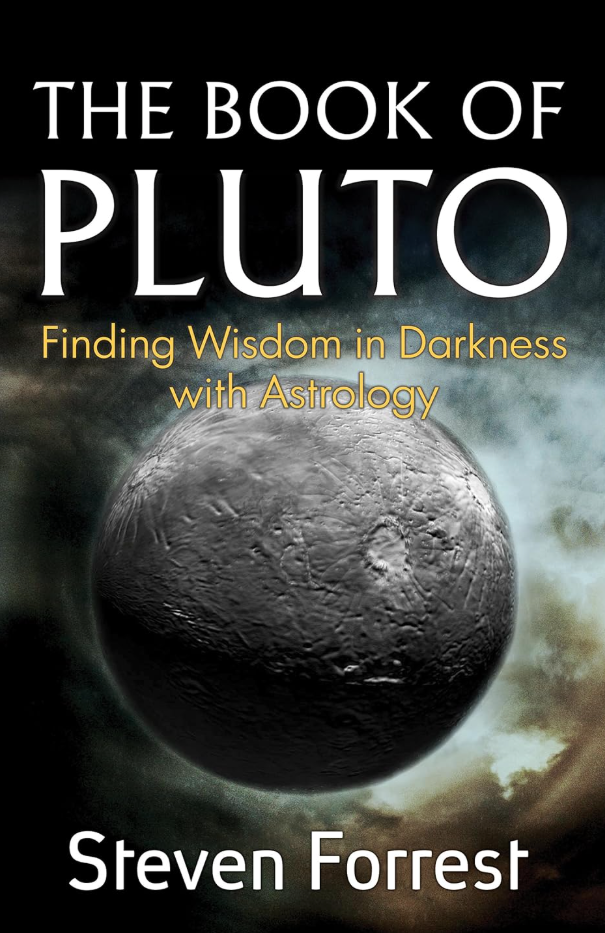
There is no way to write honestly about Pluto without acknowledging that this is not comfortable territory.
Steven Forrest’s The Book of Pluto is a book about the dark places in the chart – not because astrology should frighten us, but because healing requires honesty. Pluto speaks of wound, compulsion, survival, shadow, buried power and the long road from pain to empowerment.
It is also one of the most important books in Forrest’s wider Evolutionary Astrology landscape.
In the FCEA curriculum, The Book of Pluto becomes a required text in FCEA-304, Invisible Planets: Uranus, Neptune and Pluto. That placement is appropriate. Pluto is not beginner symbolism. It requires interpretive courage, emotional maturity and ethical care.
A careless astrologer can do harm with Pluto language, whereas a wise astrologer can help a client recognise where the wound has been trying to become power.
That is the heart of this book.
Pluto does not exist to condemn us to our trauma. It reveals where the soul has been marked, where survival strategies have hardened, and where the biggest change may become possible: leaving, forgiving, starting again.
Pluto as the Wound and the Power
Pluto is often associated with death, rebirth, shadow, sexuality, obsession, control, trauma and transformation. Those are familiar keywords. But in Steven’s work, Pluto is never merely a dramatic symbol. It is an evolutionary pressure point.
Pluto shows where something has gone underground.
It may describe pain the person could not metabolise at the time. It may show where trust was broken, power was misused, innocence was lost or survival required a defence that has now become limiting. It may also point to gifts hidden inside the wound: depth, courage, instinct, psychological perception, resilience and the capacity to help others through darkness.
That is Pluto’s paradox. The place we fear may also contain the energy we need.
The Book of Pluto is powerful because Steven looks directly at that paradox. He does not make the dark glamorous. He does not reduce it to pathology. He treats Pluto as a master teacher whose aim is ultimately liberation.
In Mystic Warrior language, Pluto is where the warrior enters the cave.
Not to live there forever. To retrieve what was lost.
Its Place in the FCEA Curriculum
The FCEA catalogue lists The Book of Pluto as a required text in FCEA-304, the course on Uranus, Neptune and Pluto. By the time students reach this point, they have already worked through the apprentice level, nodal analysis, practicum work, forecasting, relationships and the earlier 300-level courses.
That matters.
Pluto requires context. A student needs the basic chart language, the evolutionary framework, timing tools and counselling sensitivity before approaching Plutonian material in a client’s life. Otherwise there is a risk of overstatement, projection or unnecessary intensity.
FCEA-304 focuses on the transpersonal planets in the natal chart and as moving factors. That means Pluto is studied not only as a natal wound signature, but also through transits, progressions and solar arcs. These periods can line up with big changes: a divorce, a bereavement, a career ending. The astrologer must be able to recognise the depth of the process without becoming fatalistic.
The Book of Pluto supports that skill. It helps students understand Pluto as a process of empowerment rather than a sentence of doom.
Pluto and the Ethics of Interpretation
Pluto demands ethical restraint.
It is easy to speak dramatically about Pluto. It is harder to speak responsibly.
A chart does not give the astrologer permission to diagnose trauma, pry into private history or impose a story the client has not shared. Pluto symbols may suggest themes of power, fear, survival, intensity or buried pain, but they must be handled with care.
The astrologer should not force revelation. They should create a space in which the client can recognise themselves safely.
This is particularly important for me where the aim is healing, reflection and understanding – not shock, performance or fatalistic pronouncement. Pluto can be discussed in a way that is truthful and empowering without becoming sensational.
A wise Pluto reading might say: “There is a place in the chart that suggests deep survival intelligence. It may have developed through difficult experiences or through an early need to stay in control. The evolutionary question is how that protective power can become conscious rather than automatic.”
That kind of language leaves room for the client’s reality. It does not invade. It invites.
Pluto in the Natal Chart
Natal Pluto points to an area where the soul may carry intensity. By sign, it speaks to a generational field. By house, it shows a life area where something may have to end. By aspect, it reveals personal functions that may be entangled with shadow, power, fear or regeneration.
A strong Pluto doesn’t mean you’re doomed. It usually means there’s a lot of depth to work with.
Pluto in the first house may involve survival issues around identity, visibility or personal power. Pluto in the fourth may take us into family roots and emotional inheritance. Pluto in the seventh may bring intensity through relationships and projection. Pluto in the tenth may involve authority, public identity and the fear or misuse of power.
Aspects to Pluto can intensify whatever planet is touched. Pluto with the Moon may deepen emotional memory and attachment themes. Pluto with Mercury may sharpen psychological perception but also bring obsessive thought patterns. Pluto with Venus may intensify love, value and desire. Pluto with Mars may fuse action with survival charge.
The astrologer must read these patterns carefully. Pluto’s expression depends on consciousness, biography, choice and support.
That is why Forrest’s free-will orientation is so important. The lower expression is real, but it is not the whole story. The higher expression must be named too.
Pluto as a Moving Planet
Pluto transits and progressions are not usually light experiences. They often correlate with periods of stripping away, confrontation, intensification or deep psychological reorganisation. But again, fatalism is not helpful.
A Pluto period may bring endings, but not every ending is punishment. It may bring exposure, but exposure can reveal truth. It may bring loss of control, but sometimes control was the prison.
The astrologer working with Pluto timing must be both brave and careful. Too much drama can frighten the client. Too much softness can fail to honour the seriousness of the passage.
The better approach is to frame Pluto as a process of deep empowerment through truth. Something false, dead, compulsive or fear-based may be ready to transform. The client may need support, courage and patience. The process may not be quick. But it can return energy that has been trapped in survival patterns for years.
In FCEA-304, this kind of work prepares the student to hold outer-planet processes with maturity. Uranus awakens. Neptune dissolves. Pluto transforms.
Each requires a different kind of counselling language.
Pluto Shadow: Control, Compulsion and Fear
Pluto shadow is often rooted in fear.
Fear of betrayal. Fear of helplessness. Fear of exposure. Fear of being controlled. Fear of being overwhelmed. Fear of losing what cannot actually be kept.
From that fear, the psyche creates strategies. It may control. It may withdraw. It may dominate. It may obsess. It may test others. It may keep secrets. It may destroy before it can be destroyed.
These strategies once made sense. That is an important point. Pluto defences are often survival adaptations. They deserve respect, even when they now cause harm.
The evolutionary task is to bring them into consciousness. Once conscious, they can be transformed.
Control can become self-mastery. Suspicion can become discernment. Intensity can make you the calm person to have in a crisis. Survival instinct can become courage. The wound can become a source of compassion and strength.
That is why The Book of Pluto is ultimately not a depressing book. It is fierce, but it is hopeful. It says that the darkness is not the end of the story.
Pluto and the Mystic Warrior Path
For Mystic Warrior Astrology, Pluto has obvious significance.
The mystic understands that change often starts where nobody can see it. The warrior is willing to enter the difficult place without pretending it is easy. Together, they form the attitude Pluto requires: reverence, courage and honesty.
But Pluto also warns the warrior against becoming armoured. Survival is not the same as freedom. Strength is not the same as control. Power is not the same as domination.
True Plutonian power is integrated power. It is the person who has met something difficult and no longer needs to be ruled by it. It is the capacity to stand in truth without needing to manipulate the field. It is the quiet authority of someone who has entered the cave and returned with their soul more intact.
In client work, Pluto asks whether the person is ready to reclaim energy from old pain. The answer cannot be forced. But astrology can provide a map. It can say: here is the place where life may have marked you. Here is also the place where your deepest strength may be waiting.
A Personal Reflection from the FCEA Path
On the FCEA course, Pluto feels like a threshold of seriousness.
Earlier astrology study can be exciting, illuminating and sometimes beautifully affirming. Pluto work asks more of the astrologer. It asks whether we can sit with the harder parts of human experience without sensationalising them, minimising them or trying to fix them too quickly.
That is essential for the kind of practice I want Mystic Warrior Astrology to become.
Clients do not need an astrologer who is impressed by darkness. They need one who can help them understand it without being swallowed by it. They need language that gives dignity to the wound and agency to the future.
The Book of Pluto supports that kind of work. It is direct, brave and humane. It teaches that Plutonian material must be met, but also that it can be transformed.
Why Clients Need Pluto Work
Many clients arrive at a Pluto moment because something in the old life no longer works.
They may be facing endings, betrayals, power struggles, deep grief, compulsive patterns or a sense that life is stripping away what they thought they could control. They may not use the word transformation. They may simply say, “I cannot go on like this.”
Pluto astrology can help by naming the depth of the process. It can show that the crisis may not be random. It can reveal the survival pattern, the wound beneath it and the possibility of a different relationship with power.
But the language must be empowering.
The aim is not to tell the client they are broken. The aim is to help them see that what has been buried may be ready to return as strength.
That is Plutonian grace: not comfort, exactly, but power reclaimed.
Mystic Warrior Summary
Difficulty: ★★★★☆
Best suited for: Intermediate to advanced students ready for shadow, compulsion and depth work.
FCEA Path: Required for FCEA-304 and an important support for advanced evolutionary chart work.
Neil’s Rating: ★★★★★
Key Themes: Pluto, shadow, compulsion, survival, transformation, evolutionary necessity.
Why I Keep Returning to This Book
I keep returning to The Book of Pluto because it teaches courage without melodrama. Pluto can be frightening if handled badly, but Steven shows that depth work is not punishment. It is where the soul refuses superficiality. For me, this is crucial: the warrior must be willing to look, and the mystic has to remember why we go into the dark: to come back out.
Final Reflections
The Book of Pluto is not an easy book, and it should not be.
Pluto is not easy. But it is necessary.
For FCEA students, this book belongs at the point where technical astrology meets emotional courage. It asks the student to understand shadow without becoming fatalistic, to recognise trauma signatures without making invasive claims, and to speak of power in a way that restores agency.
That is advanced astrology.
In the larger FCEA path, The Book of Pluto is a reminder that Evolutionary Astrology is not only about describing potential. It’s about change. And change often starts where we least want to look.
The Mystic Warrior does not seek darkness for its own sake. But when the soul’s path leads through the cave, the warrior enters with a steady hand and the mystic remembers that even there, something worth finding may be waiting.
Where’s Pluto in your chart? If it’s sitting on something tender, go gently. And if you’d like a hand looking at it, I’m here.
Related in this series
- The Book of Neptune — longing, imagination and spiritual discernment.
- Yesterday’s Sky — the lunar nodes and reincarnational imagination.
- The Book of the Moon — lunar phases, memory and emotional safety.
This review is part of my complete Steven Forrest reading guide — or explore the wider Evolutionary Astrology Books.