Why lunar wisdom belongs at the centre of the Forrest Reading Path
Some astrological symbols announce themselves loudly. Mars acts. Jupiter expands. Uranus shocks. Pluto exposes. But the Moon is different.
The Moon does not shout. She remembers.
She carries the private weather of the soul: our needs, instincts, family patterns, emotional reflexes, ancestral echoes, and the mysterious places within us that do not respond well to logic. We can understand our chart intellectually, make brave choices, and even follow our evolutionary path with sincerity, but if the Moon is neglected, something essential remains unhealed.
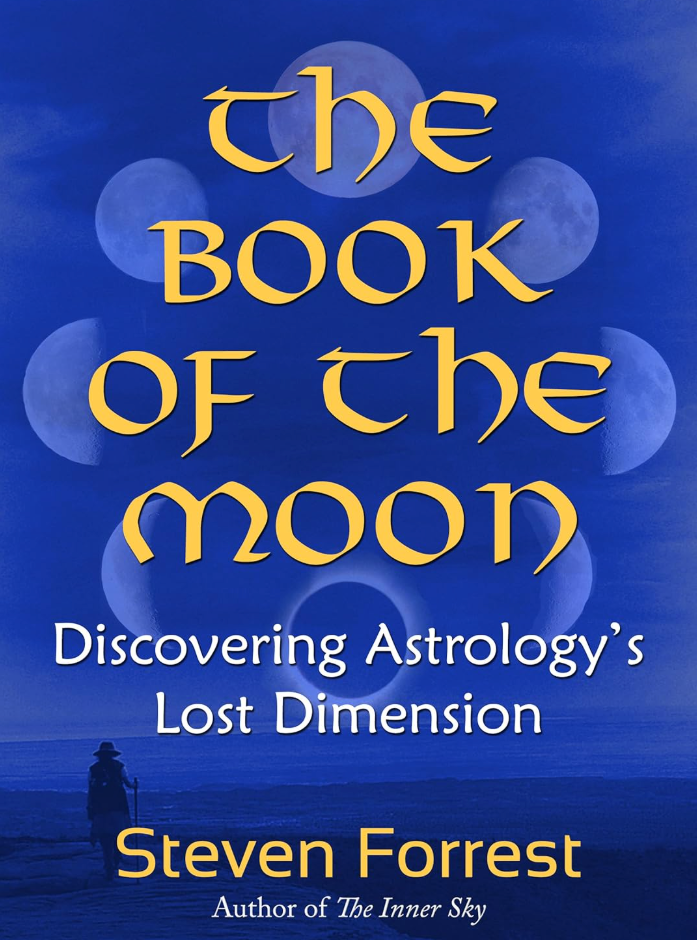
Steven Forrest’s The Book of the Moon is therefore not simply another planetary text. It is one of the emotional and spiritual keystones of the Forrest method. It is also one of my favourite of Steven’s books.
For anyone walking the FCEA path, this book has a very specific place. It is the required textbook for FCEA-301: The Moon, an advanced course devoted to the lunar world, including natal and progressed Moon phases, lunar speed, the out-of-bounds Moon, and the Moon through the signs.
That curriculum placement tells us something important. In the Forrest path, the Moon is not beginner material, even though every beginner learns their Moon sign. The sign, house and aspects of the natal Moon may be introduced early, but the deeper lunar mysteries require maturity. They ask the astrologer to listen beneath personality and into the emotional body of the chart.
The Moon Is Not Just Your Feelings
One of the most useful things about The Book of the Moon is that it rescues the Moon from over-simplification.
In popular astrology, the Moon is often reduced to emotions. That is not wrong, but it is nowhere near enough. The Moon does relate to feeling, but not in a casual or sentimental way. It shows the inner landscape we return to when we are tired, threatened, vulnerable, hungry, grieving or in need of comfort.
The Moon is the part of us that asks: where is home?
Sometimes that home is a place. Sometimes it is a person. Sometimes it is a memory. Sometimes it is a pattern that no longer serves us but still feels familiar. This is why lunar work can be so tender. The Moon is not interested in what we think should make sense. It is interested in what our nervous system, body and memory have learned to call safety.
From an Evolutionary Astrology perspective, that makes the Moon indispensable. The soul may have a noble path. The North Node may point toward growth. The Sun may call us toward authentic becoming. But the Moon often shows what must feel safe enough before we can move.
Without lunar understanding, evolutionary language can become too heroic. We might tell someone to step into their destiny without noticing that their inner child is terrified. We might describe a soul path accurately but fail to honour the emotional protection that has helped the person survive.
The Moon slows us down. It teaches compassion.
What FCEA-301 Means to Me
The fact that The Book of the Moon becomes the required text for FCEA-301 is significant. By that point, the student has already built foundations through natal interpretation, nodal work, chart reading, transits, progressions, solar arcs and relationship astrology. The Moon then opens the 300-level master sequence.
That is beautifully symbolic.
Before the advanced student moves into the personal planets, aspirational planets, invisible planets, Chiron, Eris and final practicum work, they must go back to the Moon. They must return to feeling, memory, instinct and interiority.
This is a profound pedagogical choice.
It suggests that advanced astrology is not simply about adding more techniques. It is about becoming more sensitive to the human being sitting in front of you. The Moon asks the astrologer to become more attuned, less mechanical, less eager to impress, and more willing to hear what is fragile.
That is why this book belongs so naturally in the Mystic Warrior Astrology library. The warrior without the Moon becomes hard. The mystic without the Moon becomes ungrounded. But the Moon brings tenderness, embodiment and emotional truth.
She reminds us that healing is not only about insight. It is also about being held.
Lunar Phases: The Forgotten Dimension
One of Steven’s great contributions in this book is his attention to lunar phase. Many astrologers learn the Moon’s sign and house but pay far less attention to whether a person was born at New Moon, First Quarter, Full Moon, Last Quarter, Balsamic Moon, or one of the subtler phase points in between.
That omission matters.
The lunar phase describes the relationship between the Sun and Moon. Symbolically, it tells us something about how solar purpose and lunar instinct interact. Is the person born at a moment of emergence, crisis, fulfilment, dissemination, harvest, surrender or preparation for a new cycle?
In counselling astrology, this becomes incredibly useful.
A New Moon person may carry an instinct for beginnings, even if they cannot always explain why they feel called forward. A Full Moon person may live with heightened awareness of polarity, relationship and reflection. A Balsamic Moon person may feel marked by endings, release, ancestral completion or spiritual threshold work.
These are not rigid labels. They are atmospheres.
For FCEA students, lunar phase work also deepens timing. The progressed Moon phase reveals not merely what is happening, but what kind of evolutionary season the person is inhabiting. A progressed New Moon is not the same existential weather as a progressed Last Quarter Moon. One asks for seed. The other asks for reorientation.
This is why The Book of the Moon is so useful beyond natal interpretation. It helps the astrologer understand cycles of becoming.
The Moon and the Body of Memory
The Moon has a bodily quality. It lives in the stomach, the breath, the chest, the instinctive flinch, the sudden comfort of a familiar smell, the ache of homesickness, and the soothing rhythm of a repeated ritual.
This is one reason lunar symbolism is so relevant to client work. People may come to a reading with questions about career, relationship or timing, but beneath the stated question there is often a lunar one: will I be safe, will I be loved, can I trust this, what will happen if I let go?
In Evolutionary Astrology, we can speak of past lives, karmic memory, ancestral patterning and soul intention but the Moon often shows how those great themes are felt in ordinary life. It brings the cosmic into the body. That is why the Moon can never be treated as merely passive. She may not act like Mars or initiate like Aries, but she has enormous power. If the Moon does not feel safe, the whole chart may contract.
The task is not to obey the Moon blindly. Some lunar habits are protective but limiting. Some comfort zones are prisons decorated to look like home. But we cannot simply override them. We must understand them, honour their origin, and then gently invite them to grow.
That is lunar wisdom.
The Out-of-Bounds Moon
Steven’s treatment of the Moon’s declination and the out-of-bounds Moon is especially valuable because declination is often neglected by astrologers who focus mainly on zodiacal longitude.
An out-of-bounds Moon can suggest lunar experience that does not easily conform to ordinary emotional expectations. The person may feel things in a way that is unusual, intense, unfiltered, creative, uncontained or difficult to domesticate. There can be gifts here: originality, emotional freedom, instinctive genius, deep empathy or unusual responsiveness.
But there may also be vulnerability. A person with an out-of-bounds Moon may have learned early that their needs, reactions or sensitivities did not fit the family script. They may feel emotionally other. They may need to build a form of belonging that honours their own lunar truth rather than forcing themselves into conventional patterns.
This is where Forrest’s approach is so helpful. He gives the astrologer a way to describe difference without pathologising it.
Mystic Warrior Summary
Difficulty: ★★★★☆
Best suited for: Intermediate to advanced students, practising astrologers and reflective seekers ready to deepen emotional and lunar symbolism.
FCEA Path: Required text for FCEA-301: The Moon, the opening course in the 300-level master sequence.
Neil’s Rating: ★★★★★
Key Themes: Emotional memory, lunar phases, instinct, family, healing, inner safety, sacred counsel.
Why I Keep Returning to This Book
This is the kind of book that deepens as the student deepens. At first, it may seem to be about the Moon. Later, it becomes clear that it is about how the soul experiences safety, memory and emotional truth. For an evolutionary astrologer, that is priceless. We can talk about growth, karma, transits and choice, but unless we understand the Moon, we may miss the part of the client that is still asking to be held.
Final Reflection
The Book of the Moon is one of those texts that quietly changes the astrologer. It does not simply add information. It changes the quality of listening.
That is why it belongs at the heart of the Steven Forrest Reading Path.
The Elements teach us the language of symbolic families. The outer-planet books take us into deeper evolutionary waters. But The Book of the Moon brings us home.
It reminds us that the soul is not an abstract concept. The soul has memories. The soul has needs. The soul has a body.
Related in this series
- Yesterday’s Sky — the lunar nodes and reincarnational imagination.
- The Book of Neptune — longing, imagination and spiritual discernment.
- The Book of Water — feeling, memory and healing.
This review is part of my complete Steven Forrest reading guide — or explore the wider Evolutionary Astrology Books.