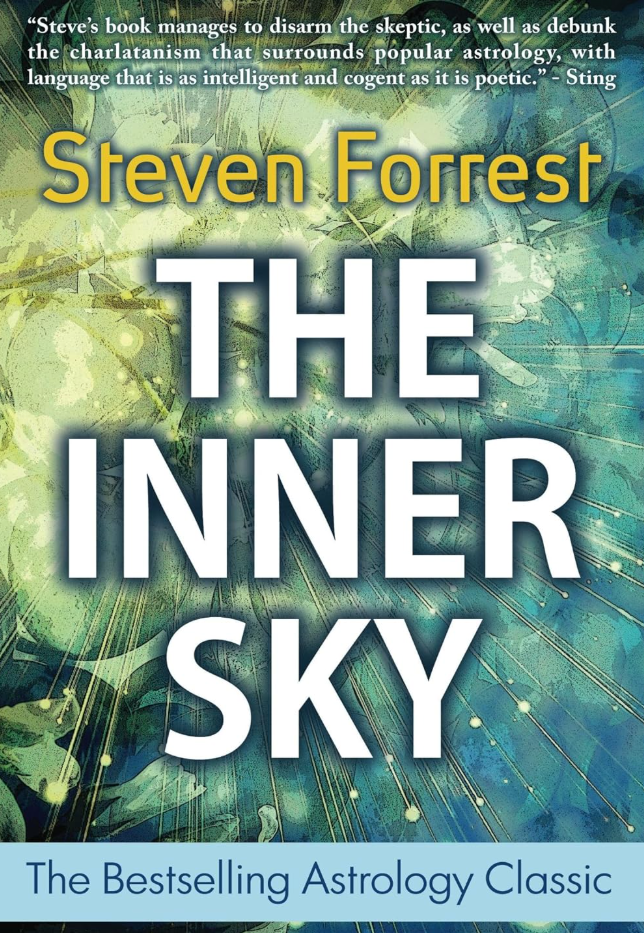
Why Steven Forrest’s foundational text still matters for developing astrologers
The Inner Sky, for me was the book that changed everything. Before I read it I was a guy that was interested in astrology, after it I was a serious astrology student aspiring to be a professional astrologer! It is one of those astrology books that can be read at more than one level.
For the beginner, it introduces the basic building blocks: planets, signs, houses and aspects. For the developing astrologer, it offers something more valuable: a way of thinking about synthesis.
That distinction matters.
Learning astrology is not difficult because there are no meanings. It is difficult because there are too many meanings. Every planet has a vocabulary. Every sign has a style. Every house has a field of life. Every aspect adds relationship, tension, ease or pressure. Before long, the student is surrounded by fragments of interpretation and unsure how to assemble them into a coherent reading.
The Inner Sky helps because it does not merely hand the reader another pile of keywords. It encourages a living relationship with the chart.
More Than a Beginner Book
At first glance, The Inner Sky looks like a foundational text. It teaches the core symbols of astrology in an accessible way. That alone makes it valuable.
But its deeper gift is its attitude.
Steven writes as though the chart is meaningful but not fixed. The symbols matter, but the person matters more. The astrologer is not being trained to pronounce fate. You are being trained to recognize patterns and help your client make wiser choices within them.
This is exactly why The Inner Sky is a core Evolutionary Astrology book.
A beginner needs clarity but a beginner also needs the right philosophical foundation. If the first books teach astrology as possibility, the student starts from a healthier place. That’s why I’d put it near the top of any beginner’s list.
The Problem With Isolated Meanings
A student might learn:
- Mars is action.
- Cancer is feeling and protection.
- The Seventh House is relationship.
- A square suggests tension or friction.
These are useful starting points but they are not yet interpretation. The deeper question is how the symbols combine.
What does Mars in Cancer in the Seventh House actually suggest? How might assertion, protection, vulnerability, conflict and relationship become entangled? Does the person fight for connection, fight against dependency, defend the partner, or defend against the partner? Is anger expressed directly, indirectly, protectively or defensively?
The answer does not come from a single keyword; it emerges from synthesis.
Steven’s strength lies in helping the reader move from vocabulary to story. The chart becomes a living sentence rather than a dictionary.
The Chart as a Field of Choice
The Inner Sky also introduces a vital principle: the same symbol can be lived at different levels of consciousness.
A Leo Sun may be expressed as warmth, generosity, performance, creativity and leadership. It may also be expressed as attention-seeking, pride, theatrical self-protection or fear of invisibility. Both are connected to the symbol. The question is not which interpretation is correct in the abstract. The question is how the person is living the symbol.
This keeps the astrologer humble.
It prevents the chart from becoming a fixed personality verdict and it also keeps the client involved. Instead of being told, “You are this,” the client can be invited to ask, “How am I expressing this, and what more conscious expression is available?”
That is the beginning of reflective astrology.
What The Inner Sky means to me
With Mystic Warrior Astrology I am not trying to produce clever readings that leave the client impressed but passive. I am aiming to support insight, responsibility and integration.
The Inner Sky helped establish that ethos.
It shows that foundational astrology does not have to be superficial. You can teach planets, signs and houses in a way that honours complexity. You can introduce free will without pretending that the chart means nothing. You can speak of destiny without removing choice.
For a client, this distinction is essential. If someone comes to astrology during a Soul Crossroads they may be frightened, confused or looking for someone to tell them what will happen. A choice-centred approach offers something more mature. It says: these are the themes, pressures and invitations. Here are the possible expressions. Now let us consider how you might meet them.
Synthesis Before Sophistication
Many students want to move quickly into advanced techniques: Solar Arcs, progressions, asteroids, traditional dignity, midpoints, rectification, evolutionary nodes etc etc. There is nothing wrong with advanced study. But advanced technique without synthesis can create confusion at a higher level.
The Inner Sky is a reminder that the foundations are not beneath us. They are the ground on which everything else depends.
Before an astrologer can interpret a progressed Moon, they need to understand the natal Moon. Before they can work responsibly with the lunar nodes, they need to understand the basic grammar of signs, houses and rulers. Before they can time a life transition, they need to know what kind of person is meeting the transition.
Foundations are not beginner material in the sense of being simple. They are beginner material in the sense of being fundamental.
The Inner Sky and the Mystic Warrior Astrology Reading Style
My approach uses The Inner Sky in three practical ways.
As a Foundation for Client Language
Steven’s language is direct enough to be understood but rich enough to avoid flat stereotypes. That helps a would be astrologer speak in a way the client can recognise.
As a Training in Synthesis
The book encourages the reader to assemble meanings rather than recite them. This is crucial for any serious chart work.
As an Antidote to Fatalism
From the beginning, Steven’s approach emphasises choice. That supports my commitment to healing-centred, non-deterministic astrology.
How to Read The Inner Sky
I would not rush it.
You could read the book once for the basic meanings, then return to it with a notebook and a birth chart. The second reading is where the real learning begins.
For each planet, ask:
- What function does this planet represent?
- How does its sign describe its style?
- What house shows the arena of life involved?
- What aspects show relationships with other planetary functions?
- What higher expression is possible?
- What defensive or unconscious expression should be watched?
Then test the interpretation against lived experience. Astrology becomes real when the student can recognise the symbol in life, not merely repeat it from a page.
Who Should Read It?
Choose The Inner Sky if you are new to astrology and want a serious but accessible starting point; if you know the basics but struggle to combine them; if you want astrology that honours free will; or if you want a warm introduction to Forrest’s voice before entering more explicitly evolutionary territory.
This is not the most technical book in the Library. Its purpose is different. It teaches the student how to enter the symbolic world of astrology without losing the human being inside it.
Summary
Difficulty: ★★☆☆☆
Best suited for: Beginners, returning students and developing astrologers who need synthesis as much as vocabulary.
FCEA Path: Foundational to the early FCEA pathway and repeatedly required alongside the practicum courses.
Neil’s Rating: ★★★★★
Key Themes: Chart synthesis, free will, planets, signs, houses, aspects, choice-centred interpretation.
Why I Keep Returning to This Book
I keep returning to The Inner Sky because it establishes the attitude I want Mystic Warrior Astrology to carry. It teaches the basics, but never turns the client into a list of traits. It shows that clarity and compassion can live together. For a serious astrology student, that is not optional, it is the ground of every good reading.
Final Reflection
The Inner Sky is foundational because it teaches more than astrology. It teaches a stance.
What did I take from it? Stay curious, keep it human, and leave the choices with the person whose chart it is. Have you read it? I’d love to know what you made of it.
That is an excellent beginning for any astrologer. It is also a very good foundation for Mystic Warrior Astrology.
Read The Inner Sky when you want to learn the language of the chart without losing the dignity of the person who lives it.
Related in this series
- The Changing Sky — transits, progressions and evolutionary timing.
- Yesterday’s Sky — the lunar nodes and reincarnational imagination.
- The Book of Pluto — wound, shadow and evolutionary power.
This review is part of my complete Steven Forrest reading guide — or explore the wider Evolutionary Astrology Books.