How planetary cycles can help us meet life’s Soul Crossroads with greater awareness
Astrology as a language of timing
The natal chart describes the pattern of the sky at the moment of birth. It offers a symbolic map of our temperament, potential, conflicts, gifts, and evolutionary questions. Yet a birth chart is not static. The planets continue to move, forming new relationships with the natal chart throughout life. These moving relationships are called transits.
Some transits pass quickly and colour a day or two. Others unfold over months or even years, especially when an outer planet slows, stations, or crosses the same natal point several times. The longer cycles can accompany profound periods of maturation, release, awakening, and reorientation. These are the astrological rites of passage.
A transit is not a sentence handed down by the sky. It is a season of possibility, pressure, and meaning.
What is a transit?
A transit occurs when a planet in the current sky forms an aspect to a planet, angle, or sensitive point in the natal chart. The nature of the transiting planet, the natal planet being contacted, the aspect between them, and the houses involved all contribute to the interpretation.
A Saturn transit to natal Venus, for example, may bring questions of commitment, self-worth, relationship boundaries, financial responsibility, or the need to define what truly matters. It does not tell us that a relationship must end or that money must become difficult. It describes a period in which Venusian matters are being asked to mature through Saturn’s language of reality, time, responsibility, and structure.
This is why responsible astrology does not reduce a transit to a single prediction. The same symbolism can express itself in many ways, depending upon the natal chart, age, life circumstances, previous choices, and level of awareness.
Weather, not fate
The weather metaphor is useful. Knowing that rain is likely does not determine what you will do that day, but it helps you prepare. You may carry an umbrella, change your route, protect something vulnerable, or decide that walking in the rain is exactly what you need.
Transits work in a similar way. They describe the prevailing conditions and the kinds of experience that may become more available or more demanding. They can help us understand why a familiar strategy is no longer working, why an old question has returned, or why a part of us that has been quiet for years suddenly asks to be heard.
The aim is not to control life or eliminate uncertainty. It is to participate more consciously in the unfolding story.
Transits often unfold in stages
A slow-moving planet may make one exact contact to a natal point, or it may move across it, turn retrograde, and return several times. This can create a three-part process: the first contact introduces the theme, the retrograde passage deepens or internalises it, and the final contact may bring greater integration or a clearer outer response.
These stages are not rigid. Life rarely follows a neat astrological script. They are better understood as waves within a longer developmental process, each offering another opportunity to see, feel, and respond.
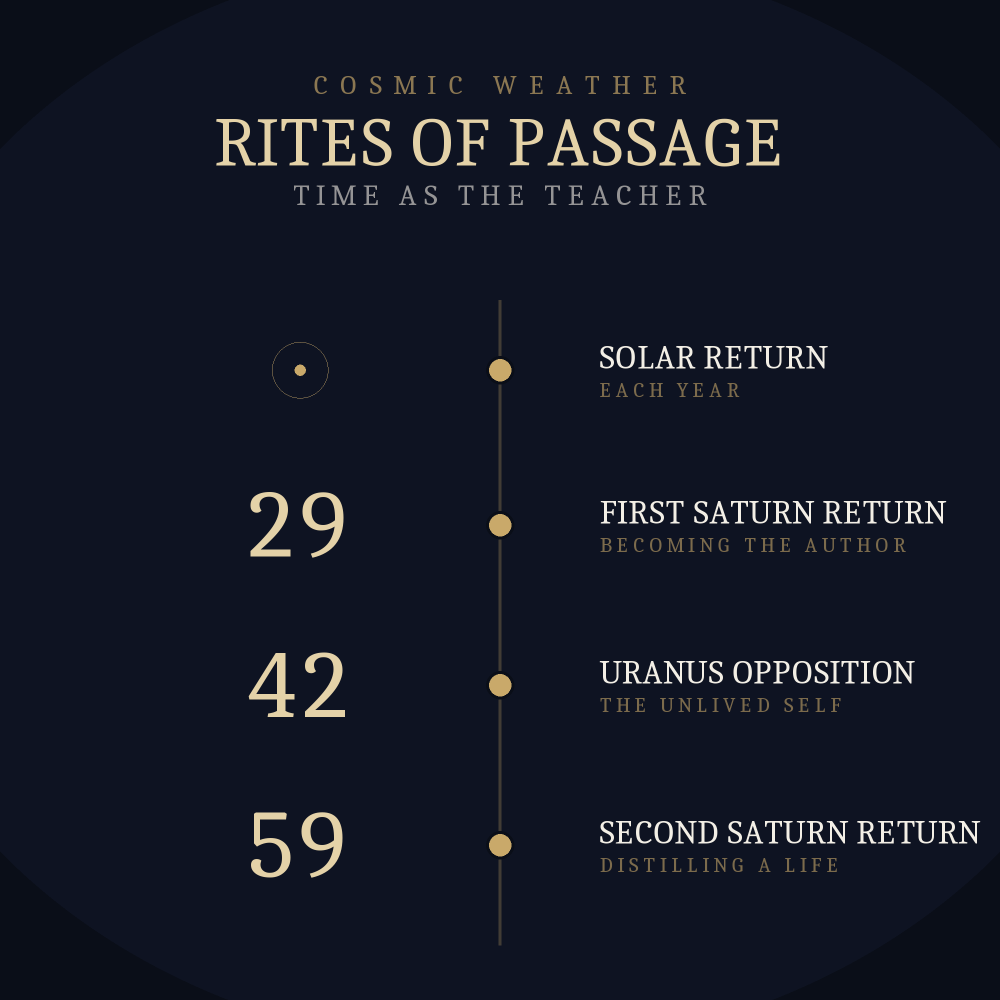
The Solar Return – an annual lens
Every year, close to the birthday, the transiting Sun returns to the exact zodiacal position it occupied at birth. A chart cast for that moment is called the Solar Return chart. Strictly speaking, it is a return chart rather than a transit interpretation, but it belongs naturally within the wider study of astrological timing.
The Solar Return can describe the themes, priorities, and emotional atmosphere of the year ahead. The Return Ascendant suggests the approach or stance through which the year may be met. The house containing the Sun points towards a central area of attention. The Moon describes an important emotional need or rhythm, while planets close to the angles often carry particular emphasis.
The Solar Return should always be read in relationship with the natal chart and the wider timing picture. It does not replace the birth chart, nor does it promise specific events. Instead, it helps us ask a more useful question:
What part of my ongoing life story is ready to receive more attention this year?
Used in this way, the Solar Return becomes less like a forecast delivered from outside and more like an annual conversation with the evolving self.
The First Saturn Return – becoming the author of adult life
Saturn takes approximately twenty-nine and a half years to return to its natal position, so the First Saturn Return usually unfolds between the ages of twenty-eight and thirty. It is often one of the clearest thresholds between early adulthood and a more fully owned adult life.
By this stage, many of the structures inherited from family, education, culture, or youthful expectation have been tested by experience. Some remain strong and meaningful. Others begin to feel too small, too provisional, or no longer true. Saturn asks us to look honestly at what we have built and whether it can carry the weight of the person we are becoming.
This can coincide with decisions about work, commitment, home, parenthood, responsibility, or direction. Yet the deeper process is not defined by any particular milestone. A person may marry during the Saturn Return, leave a marriage, begin a career, change careers, or make no dramatic outer change at all. The shared theme is the need for greater authenticity, accountability, and structural integrity.
When Saturn feels difficult
Saturn can feel heavy when we have outgrown a structure but are afraid to change it, or when we want lasting results without accepting the patience and discipline they require. Feelings of limitation, delay, self-doubt, or pressure may become more visible.
This does not mean Saturn is punishing us. Often it is revealing where our life needs a firmer boundary, a more realistic plan, a clearer commitment, or a compassionate acceptance of limits.
A more conscious expression
- Taking responsibility without turning responsibility into self-punishment.
- Choosing commitments that reflect genuine values rather than social expectation.
- Building boundaries that protect energy, time, and emotional wellbeing.
- Accepting that meaningful work develops gradually through practice and persistence.
- Releasing roles that once offered security but now prevent further growth.
What am I ready to take seriously because it genuinely belongs to me?
The First Saturn Return is not a coronation granted to those who make perfect choices. It is a gradual initiation into becoming more accountable for the shape and substance of our lives.
The Second Saturn Return – distilling a life
The Second Saturn Return usually occurs between the ages of fifty-eight and sixty. It is sometimes described as a review of what has been built since the first return, but the process is more than an audit of achievement. It can be a profound reorientation towards meaning, legacy, and the use of remaining time.
At this stage, identities that have organised life for decades may begin to change. Professional roles can loosen, family responsibilities may shift, the body asks for a different relationship with pace and energy, and questions that once seemed distant become more immediate: What matters now? What deserves to continue? What is complete? What remains unlived?
For some, this period brings simplification. For others, it brings renewed vocation or a more honest form of contribution. The emphasis is not necessarily on doing less, but on doing what is more essential.
The shadow and the gift
The shadow of the Second Saturn Return can include fear of irrelevance, regret about roads not taken, or a rigid attachment to roles that once provided identity. These feelings deserve compassion rather than judgement. They may be signals that a new form of authority is trying to emerge – one based less on status and more on lived wisdom.
Its gift is the opportunity to distil experience into something honest and useful: mentorship, service, creative work, deeper relationship, spiritual maturity, or simply a life with fewer false obligations.
What is still asking to be completed, embodied, shared, or released?
The Uranus Opposition – awakening the unlived self
Uranus takes about eighty-four years to complete the zodiac. Around the early forties, it reaches the halfway point and opposes its natal position. This Uranus Opposition is commonly associated with the midlife crisis, but the word crisis can obscure the deeper invitation. At its heart, this is a cycle of awakening.
By midlife, we have usually made many necessary adaptations. We have taken on roles, responsibilities, and identities that allowed us to belong and function. Some of those adaptations remain authentic. Others may have required us to silence qualities that felt inconvenient, unconventional, or unsafe.
Uranus can bring those neglected parts of the self back into awareness. Restlessness, sudden insight, a need for greater freedom, or a strong sense that time matters may become difficult to ignore. The purpose is not disruption for its own sake. It is the recovery of a more truthful relationship with individuality and possibility.
Freedom without unnecessary destruction
When the Uranian impulse has been suppressed for too long, change may first appear as rebellion, impulsiveness, or the desire to escape every commitment. Yet genuine freedom is not the same as acting without regard for consequence. The more conscious task is to distinguish between structures that are merely restrictive and responsibilities that still express our values.
- Where have I become too identified with the role I perform for others?
- What part of me has been waiting for permission to develop?
- Which changes would create greater truth without causing avoidable harm?
- How can I make room for experimentation before demanding a total reinvention?
Met with awareness, the Uranus Opposition can begin a second adulthood – one in which freedom is less about rejecting the past and more about becoming fully present to the life that still wants to be lived.
The evolutionary key – conscious participation
Evolutionary Astrology views time as meaningful, but not mechanical. A transit can activate an old pattern, intensify a developmental need, or open a new possibility. It cannot remove free will, erase circumstance, or decide the level on which a symbol must be lived.
Saturn may ask for maturity, but maturity can mean building, ending, waiting, committing, or accepting a limit. Uranus may ask for freedom, but freedom can mean a dramatic change or a quiet inner permission to become more fully oneself. The Solar Return may emphasise a field of experience, but how that field is entered remains part of the living conversation between chart and consciousness.
A final reflection
The great rites of passage do not arrive to tell us that we have failed. They mark thresholds at which an old way of living may no longer be sufficient. Sometimes the transition is exciting; sometimes it is painful; often it is both.
Astrology can help us recognise the season, find language for the inner process, and approach change with greater compassion. It cannot spare us the work of living, nor should it. Its gift is not certainty, but meaningful orientation.
Time is not our enemy, and the planets are not judges. Each cycle asks a different question. Our freedom lies in the quality of the answer we are willing to live.
The chart describes the invitation. Conscious participation is how we answer it.
Which season are you in right now?