How the progressed Moon reveals the changing emotional seasons of a life
The quieter language of change
Some astrological cycles arrive with unmistakable force. A major transit can coincide with a visible Soul Crossroads: a change of work, a relationship beginning or ending, a move, a loss, or a new direction. Secondary Progressions often speak more quietly. Their movement is usually felt first beneath the surface, as a gradual change in mood, identity, focus, or emotional need.
This does not make them less important. In many cases, progressions describe the inner readiness that allows an outer event to become meaningful. They show how we are changing from within – sometimes before we have language for what is happening.
Transits describe the weather around us. Progressions reveal the season unfolding within us.
How Secondary Progressions work
Secondary Progressions use a symbolic day-for-a-year system: each day after birth corresponds to one year of life. To explore the progressed chart at age thirty, for example, an astrologer studies the planetary positions approximately thirty days after birth.
This is symbolic rather than literal time. The planets have not physically moved to those positions in the present sky; instead, the progressed chart offers a map of maturation. It can describe how the natal potential is ripening, which parts of the personality are becoming more conscious, and where the soul may be ready for a new chapter.
Progressions are therefore best read alongside the natal chart and the wider timing picture. They do not guarantee particular events, and they should never be used as a substitute for context, choice, or common sense. Their value lies in helping us understand why a particular period feels different – and what that difference may be asking of us.
The Progressed Moon – our emotional metronome
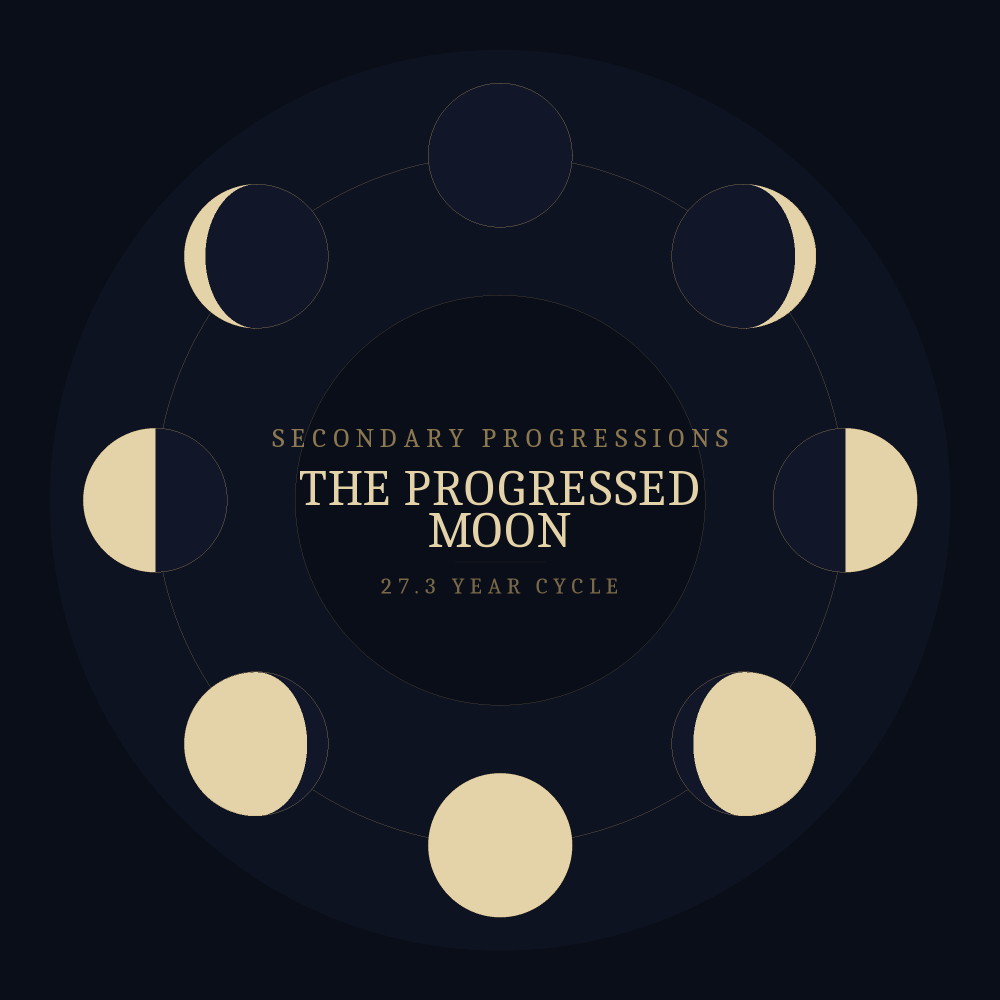
The Progressed Moon is the most immediate and widely used of the secondary progressions. It moves, on average, about one degree per month, spending a little over two years in each sign and taking roughly twenty-seven to twenty-eight years to complete the zodiac.
Because the Moon symbolises instinct, emotional security, belonging, memory, and the ways we nourish ourselves, its progressed movement describes the changing emotional emphasis of our lives. It does not replace the natal Moon; rather, it shows how our relationship with that natal need is developing.
Sign, house, and aspect
When the Progressed Moon changes sign, the emotional tone often changes. A period of inwardness may give way to greater visibility; a need for stability may slowly become a need for movement, dialogue, or experimentation. These shifts are rarely instantaneous. They are more like one season blending into another.
The house position shows where this emotional development is seeking expression. A Progressed Moon moving through the Fourth House may draw attention towards home, family, roots, or inner security. In the Tenth House, questions of contribution, vocation, visibility, and responsibility may become more emotionally significant.
Aspects from the Progressed Moon to natal planets can mark periods when particular themes become more personally felt. A contact with Saturn may bring a need for emotional boundaries or steadiness. A contact with Uranus may awaken a longing for greater freedom. A contact with Neptune can heighten sensitivity, imagination, and the need for discernment. No aspect has only one outcome; its expression depends upon the natal chart, the person’s circumstances, and the degree of conscious participation.
The Progressed Lunar Return – coming home to yourself
Around the age of twenty-seven or twenty-eight, the Progressed Moon returns to the sign and degree it occupied at birth. This is the first Progressed Lunar Return. Further returns occur at roughly the same interval later in life, each closing one emotional cycle and beginning another.
The first return can feel especially significant because it arrives close to the First Saturn Return. Before Saturn asks us to take fuller responsibility for the shape of our adult lives, the Progressed Moon invites us to consider the emotional foundations on which that life is being built.
This can be a period of reflection around nurture, attachment, family patterns, safety, and belonging. We may recognise that an old source of comfort no longer nourishes us, or that a coping strategy developed in childhood has become too limiting for adult life. Memories and feelings may resurface, not as proof that something has gone wrong, but because the psyche is ready to meet them from a more mature place.
What do I need now – and can I learn to offer some of that care to myself?
The Progressed Lunar Return and the Saturn Return
These two cycles are often described as an inner-outer sequence. The Progressed Lunar Return turns our attention towards emotional truth. The Saturn Return asks how that truth will be given structure, commitment, and form.
The Moon may reveal where we feel undernourished, overly dependent, emotionally defended, or ready to grow. Saturn then asks us to make adult choices: to create firmer boundaries, accept responsibility, simplify what has become unsustainable, or build something that can endure.
This does not mean that anyone who finds the Lunar Return difficult is destined for a painful Saturn Return. Astrology is not a system of reward and punishment. It is more helpful to say that emotional awareness can make Saturn’s restructuring more conscious. When we know what we truly need, we are better placed to build a life that can support it.
Two ways of meeting the same threshold
Imagine two people approaching this period with a similar sense of restlessness. One keeps moving faster, filling every quiet moment and treating discomfort as something to escape. The other becomes curious. They begin journalling, seek support, have a conversation they have long avoided, or make more space for rest and reflection.
Neither person’s life will unfold according to a fixed script. Yet the second person may enter the Saturn Return with a clearer understanding of what is emotionally sustainable. They may still face difficult choices, but those choices are less likely to feel completely disconnected from their inner life.
The difference is not spiritual superiority. It is simply the difference between meeting a transition unconsciously and meeting it with growing awareness.
Signs that an emotional cycle may be changing
The Progressed Lunar Return will not feel the same for everyone, but common experiences can include:
- A growing awareness that familiar emotional habits no longer provide the same comfort.
- A wish to withdraw temporarily from environments or relationships that feel overstimulating or inauthentic.
- Childhood memories, family themes, or old feelings returning to consciousness.
- A desire to reset the pace, priorities, or emotional atmosphere of daily life.
- A stronger longing for authentic belonging, meaningful connection, or restorative solitude.
- A sense that an old chapter is ending, even before the next one is fully visible.
Working consciously with the Progressed Lunar Return
1. Locate the cycle
Identify when the Progressed Moon returns to its natal position, then consider its sign, house, and close aspects. These details help describe the emotional territory being revisited.
What part of life is asking for a more emotionally honest response?
2. Listen before acting
Not every feeling requires an immediate decision. Allow the emotional weather to become clearer before making major changes solely to relieve temporary discomfort.
What becomes visible when I stop trying to fix the feeling straight away?
3. Notice inherited patterns
Pay attention to beliefs about care, duty, safety, and belonging that may have been learned in childhood or within the family system. Some will remain valuable; others may need to be updated.
Which emotional rules still belong to me – and which have I simply carried forward?
4. Become a steadier inner parent
Consider how you can meet your present needs with greater maturity and compassion. This may involve clearer boundaries, healthier routines, asking for support, or offering yourself the patience you once needed from others.
What would kind, adult self-care look like in practice this week?
5. Prepare the ground for Saturn
Look gently but honestly at the structures of your life. Which commitments support your emotional wellbeing? Which ones depend upon an older version of you? Saturn’s work becomes more meaningful when it grows from self-knowledge rather than fear.
What foundation am I now ready to strengthen, reshape, or release?
A final reflection
Secondary Progressions remind us that growth is not always dramatic. Much of it happens quietly: through changing needs, deepening self-knowledge, and the gradual recognition that we can no longer live from an earlier emotional script.
The Progressed Lunar Return is not an exam that we pass or fail. It is an invitation to pause at the end of one inner cycle and listen for what the next one requires. The First Saturn Return may then help us give that emerging truth a stronger container in the outer world.
The deeper question is not whether we can predict exactly what will happen. It is whether we can become present enough to recognise the person we are becoming – and build a life that offers that person somewhere honest to live.
The inner season changes first. With awareness, the outer life can begin to change with it.