Building a life with greater honesty, responsibility and inner authority
When the life you have built asks to become more honest
The Saturn Return is often introduced as astrology’s great test of adulthood. That description captures some of its seriousness, but it can also make the cycle sound like a punishment waiting to happen. Saturn is subtler than that. Its return invites us to examine the structures that hold our lives together and ask whether they still reflect who we are becoming.
The period may coincide with commitment, separation, promotion, redundancy, parenthood, relocation, grief or a quieter reckoning with time. Yet no single event defines a Saturn Return. For some people the outer life changes dramatically. For others, the most important development is internal: a clearer boundary, a sober decision, or the recognition that an old identity can no longer carry the future.
The Saturn Return is not a cosmic pass-or-fail examination. It is a meeting with reality – and an invitation to build from what is true.
What is a Saturn Return?
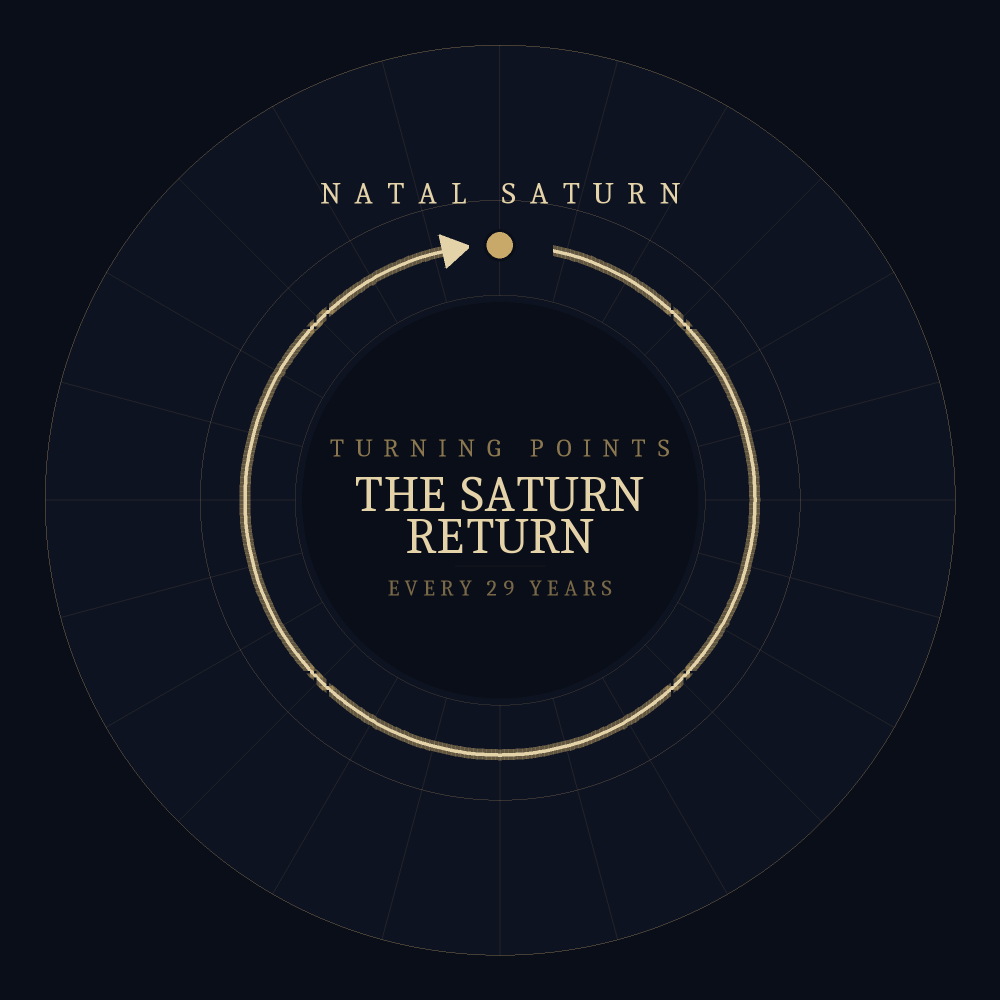
Saturn takes roughly twenty-nine and a half years to travel around the zodiac. A Saturn Return occurs when transiting Saturn comes back to the same zodiacal position it occupied at birth. Because Saturn may move back and forth across that degree during its retrograde cycle, the return can involve more than one exact contact and is better understood as a period than as a single day.
The first return usually unfolds around ages twenty-eight to thirty. A second arrives around fifty-eight to sixty, and some people experience a third in their late eighties. Each belongs to a different stage of life, but all three revisit the same natal Saturn story: our relationship with responsibility, limitation, authority, time, competence and inner structure.
What has become mature enough to take form – and what has become too small, brittle or borrowed to continue?
How long does a Saturn Return last?
Although astrologers speak of the Saturn Return as a single homecoming, it is really a season rather than a date. Because Saturn turns retrograde for part of each year, it often crosses its natal degree not once but three times — moving forward, retreating back, then advancing again — over roughly twelve to eighteen months. Many people feel the themes gathering before the first exact contact and settling for a while after the last, so the whole passage commonly spans one to two years.
The first return, around ages twenty-eight to thirty, tends to be felt most keenly, because it is the first time Saturn asks us to become the author of our own life. If you would like a closer look at that particular threshold — what it brings and how to meet it — I have written a companion piece on the Saturn return at 29.
Saturn in Evolutionary Astrology
In an Evolutionary Astrology framework, Saturn describes the structures through which consciousness becomes embodied. It shows where we meet limits, but also where persistence can develop into mastery. It may describe rules inherited from family, culture or earlier experience, along with the inner authority we gradually build by testing those rules against life.
Saturn is sometimes reduced to fear, restriction or karma. Those themes can be present, but they are not the whole archetype. Healthy Saturn gives containment, patience, discernment, commitment and the capacity to turn intention into something sustainable. Without Saturn, inspiration may remain a possibility rather than becoming a life.
The return brings this natal function into focus. It asks us to distinguish between responsibility and over-responsibility, between a meaningful commitment and a role maintained through fear, and between accepting a genuine limitation and allowing an old belief to limit us unnecessarily.
Reading the return through the natal chart
The sign of natal Saturn describes the style in which Saturnian lessons are approached. The house shows the life arena in which questions of structure, authority and maturity are likely to become especially personal. Aspects to Saturn reveal the other parts of the psyche involved in the story.
A Saturn Return should therefore never be interpreted from Saturn’s sign alone. A seventh-house Saturn does not automatically predict marriage or divorce. A tenth-house Saturn does not guarantee a promotion or career collapse. The natal chart, the current transits and progressions, the person’s circumstances and their own choices all shape how the symbolism finds expression.
Example: Saturn in the Seventh House
With Saturn in the Seventh House, the return may bring a serious review of partnership. The central issue is not simply whether a relationship stays or ends. It may concern the quality of commitment, the ability to negotiate boundaries, the fear of dependence, the habit of carrying more than one’s share, or the need to relate as one adult to another.
For one person this could coincide with making a lasting commitment. For another it could mean recognising that loyalty has become self-abandonment. Someone else may remain in the same relationship while transforming the agreements within it. The archetype is consistent; the biography is not predetermined.
Common experiences during the first return
The first Saturn Return often arrives when inherited definitions of adulthood are beginning to lose their authority. By the late twenties, we may have gathered enough experience to see which ambitions are genuinely ours and which were adopted to secure approval, safety or belonging.
Themes can include:
- taking a vocation more seriously – or admitting that an established path no longer fits
- reviewing commitments and the boundaries that make intimacy sustainable
- meeting consequences without turning them into self-condemnation
- becoming realistic about time, energy, money, health and capacity
- grieving unlived possibilities while choosing more deliberately among those that remain
These experiences are not proof that Saturn is causing hardship. They reflect a developmental period in which the distance between appearance and reality becomes harder to ignore.
How the Saturn Return shows up in love, work and home
Because Saturn governs structure wherever it is found, the return is felt most where our commitments are most defined. The house it occupies colours the emphasis, but these are the arenas in which its questions most often surface.
Work and vocation
Saturn frequently brings a sober reckoning with livelihood: a pull toward work that suits who you are, a decision to commit properly to a path, or the honest admission that an established role no longer fits. The invitation is not simply to achieve, but to build something that is genuinely yours.
Love and commitment
Relationships often reach a point of definition — deepening into lasting commitment, renegotiating the agreements within a partnership, or acknowledging what has quietly run its course. The theme is rarely “stay or leave” so much as learning to relate as one adult to another.
Home, family and self
Questions of home, roots and adult independence come to the fore, along with a more realistic relationship to time, energy, money and health. Saturn tends to reward those who tend their foundations rather than those who simply push hardest.
If you would like to see how these themes are moving through your own chart, a natal chart reading reads the return in the context of your whole map, while a cosmic weather reading looks at the live timing.
The difference between pressure and punishment
Saturnian periods can feel heavy because they concentrate attention. A deadline, duty, loss or limitation may remove options we assumed would remain open. Yet pressure is not the same as punishment. Some limits are imposed by circumstance; others reveal where we have postponed a necessary decision; still others teach us to respect the body, the calendar or the emotional capacity available to us.
If you’re in the middle of it, you haven’t failed some exam. Pressure isn’t punishment. A good reading helps you work out what is real, what support you need, what belongs to you, and what no longer does.
Saturn asks for responsibility without shame, discipline without cruelty, and authority without abandoning tenderness.
Working consciously with the Saturn Return
1. Take an honest inventory
Notice which structures are nourishing and which are maintained mainly through fear, image or inertia. Include work, relationships, finances, routines and the promises you make to yourself.
2. Separate responsibility from burden
Ask what is genuinely yours to carry. Mature responsibility includes asking for help, renegotiating an agreement and recognising when a load has become unsustainable.
3. Choose fewer, deeper commitments
Saturn often clarifies through subtraction. This is not necessarily about doing less forever; it is about giving time and form to what matters enough to endure.
4. Build in stages
The Saturn Return rarely requires one perfect decision. Sustainable change is usually created through repeated actions, realistic timelines and structures that can survive ordinary life.
5. Let grief have a place
Choosing one path means releasing others. Grief does not prove that the choice is wrong. It may be part of acknowledging the life stage that is ending.
The second return: authority, simplification and legacy
The second Saturn Return revisits the natal story from a different vantage point. Questions that once concerned becoming an adult may now concern how to use experience wisely, which responsibilities remain meaningful, and what kind of legacy is being created through the way one lives.
This period can invite simplification, retirement or renewed vocation. It may bring the freedom to stop performing roles that have outlived their purpose. It can also reveal where age, health or circumstance require a different relationship with control. The work is not to prove continuing usefulness, but to inhabit authority with greater honesty and proportion.
Frequently asked questions about the Saturn Return
What age is the Saturn Return?
The first Saturn Return falls at around twenty-eight to thirty, the second at about fifty-eight to sixty, and a third — for those who reach it — in the late eighties. You can find your own exact dates with the free Saturn Return Calculator.
How long does a Saturn Return last?
The exact contacts usually span twelve to eighteen months because of Saturn’s retrograde cycle, and the felt season often runs a little longer — commonly one to two years in all.
Is the Saturn Return a bad thing?
No. It can feel demanding because it concentrates attention on what is real, but pressure is not punishment. It is a developmental passage — an invitation to build a life with more honesty and inner authority, not a test you can fail.
Does everyone have a Saturn Return?
Yes. Saturn takes roughly twenty-nine and a half years to circle the zodiac, so everyone who lives long enough meets their first return around the age of thirty, whatever their sign.
What happens after the Saturn Return?
The years that follow are usually a time of consolidation — living into the commitments you have clarified and building on the more honest foundation the return helped you lay.
A foundation that can hold the person you are becoming
The Saturn Return does not demand a conventional life. It asks for an accountable one. The structure that emerges may be a marriage, a business, a creative practice, a simpler way of living or the courage to leave a role that no longer has integrity.
Saturn’s deeper gift is not certainty. It is the growing trust that comes from meeting reality, making considered choices and discovering that inner authority can be built.
So, what are you building? The free Saturn Return Calculator is a good place to start.