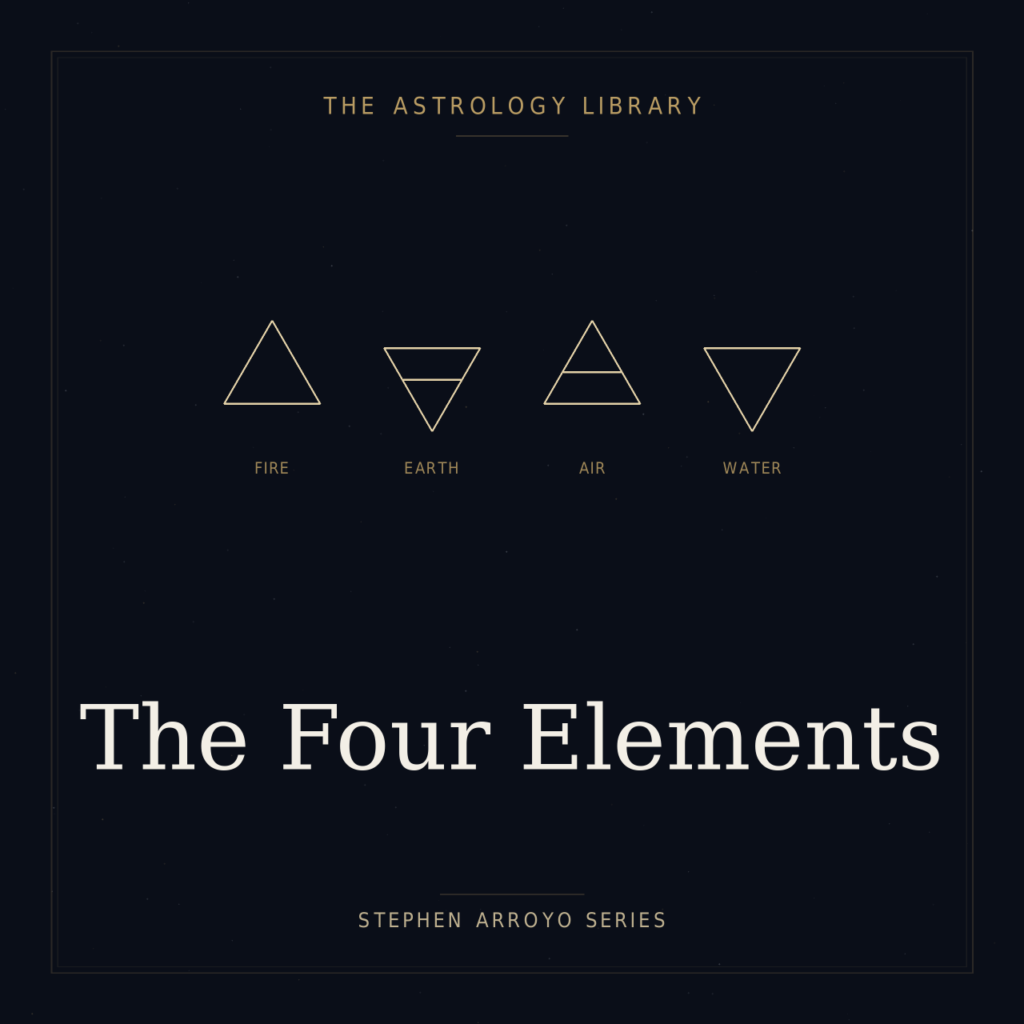
A Stephen Arroyo-inspired guide to Fire, Earth, Air and Water
The elements are not personality types
The four elements are often introduced early in astrology. Fire, Earth, Air and Water can seem so familiar that we move past them too quickly. Stephen Arroyo asks us not to do that.
In his work, the elements are not simple labels or personality categories. They are modes of life. They describe how a person experiences energy, seeks nourishment, responds to the world and restores balance.
This is why the elements are foundational for Mystic Warrior Astrology. They help us speak about the chart in a way that is direct, embodied and useful. Before analysing every detail, we can ask: what kind of energy is this person most naturally attuned to?
The elements are the climate of the chart. They tell us what kind of energy the person breathes most easily.
Fire: vitality, inspiration and direct experience
Fire is the element of life-force, inspiration, confidence, spontaneity and direct engagement. It seeks meaning through action, vision and the felt sense that life is worth entering fully.
A strong Fire emphasis may show a person who needs enthusiasm, challenge, freedom and creative expression. Fire does not usually want to analyse life from a distance. It wants to participate, risk, move and discover what is possible by doing.
At its best, Fire brings courage, faith, generosity and the ability to animate others. It can lift a room, begin a venture, defend a vision or restore hope when life has become too cautious.
Out of balance, Fire may become impatient, reckless, self-centred or addicted to intensity. It may burn through resources, resist reflection or confuse excitement with purpose.
In consultation, Fire needs language that honours vitality without excusing impulsiveness. The question is not, “How do we suppress the fire?” It is, “What vision is worthy of this energy?”
Earth: embodiment, form and practical reality
Earth is the element of embodiment, patience, practicality, rhythm and material reality. It seeks meaning through what can be built, touched, sustained and trusted over time.
A strong Earth emphasis may show a person who needs structure, reliability, competence and contact with the concrete world. Earth does not usually thrive on abstraction alone. It wants to know what works, what lasts and what can be relied upon.
At its best, Earth brings steadiness, craft, endurance, realism and the ability to make an idea useful. It can turn inspiration into form and intention into habit.
Out of balance, Earth may become rigid, overly cautious, materialistic or resistant to emotional and spiritual dimensions that cannot be measured immediately. It may stay with the familiar long after life is asking for movement.
In consultation, Earth needs respect. It is easy for more spiritual language to dismiss Earth as mundane. But without Earth, no insight becomes practice. The question becomes, “What structure would help this person live the change rather than merely understand it?”
Air: language, perspective and exchange
Air is the element of thought, language, connection, perspective and conceptual movement. It seeks meaning by linking ideas, comparing viewpoints, communicating and creating space between stimulus and response.
A strong Air emphasis may show a person who needs conversation, intellectual freedom, social exchange and the ability to understand experience through language. Air wants room to think.
At its best, Air brings clarity, objectivity, humour, dialogue and the capacity to see a pattern from more than one angle. It can translate experience into understanding and help others name what has been confusing.
Out of balance, Air may become detached, over-mentalised, inconsistent or uncomfortable with emotional immediacy. It may explain feelings rather than feel them, or keep life interesting without becoming fully involved.
In consultation, Air needs intelligent engagement but may also need grounding in felt reality. The question becomes, “How can insight become contact rather than avoidance?”
Water: feeling, memory and belonging
Water is the element of feeling, imagination, memory, empathy and emotional belonging. It seeks meaning through depth, attachment, atmosphere and the subtle currents that connect inner and outer life.
A strong Water emphasis may show a person who needs emotional safety, intimacy, privacy and symbolic meaning. Water often knows through resonance rather than analysis. It feels into the field.
At its best, Water brings compassion, sensitivity, intuition, healing capacity and the ability to remain with the vulnerable or unspoken.
Out of balance, Water may become overwhelmed, fused with others, nostalgic, defensive or unable to separate present reality from emotional memory. It may absorb more than it can process.
In consultation, Water needs gentleness but not sentimentality. The question becomes, “What helps this person feel without drowning, connect without merging and protect sensitivity without closing the heart?”
Elemental balance and imbalance
An elemental imbalance is not a defect. A low element does not mean the person lacks that part of life completely. It may indicate that the function is less automatic, more projected, more deliberately cultivated or sought through other people and environments.
A low Fire chart may need practices that restore vitality and personal initiative. A low Earth chart may need routines, body-based grounding and practical support. A low Air chart may need language, perspective and space to think. A low Water chart may need emotional literacy, permission to feel and safe containers for vulnerability.
A heavily emphasised element can also create difficulty. The strongest energy in the chart may become the place of overidentification. Strong Fire may demand constant momentum. Strong Earth may cling to security. Strong Air may live in analysis. Strong Water may organise life around emotional climate.
The work is not to make every chart perfectly balanced. The work is to understand the native pattern and help the person relate to it consciously.
Reading the elements in the whole chart
Elemental analysis should not be reduced to counting Sun signs. The whole chart matters. The Sun, Moon, Ascendant, personal planets, angular planets and dominant configurations all contribute to the elemental tone.
A person may have little Water by sign but a powerful Moon or Neptune. Another may have many Air placements but a heavily aspected Saturn that restricts communication. Elemental language must therefore be held within the full chart picture.
This is where Arroyo’s approach is strongest when combined with other methods. The elements provide the felt atmosphere; planetary condition and chart hierarchy show how that atmosphere is organised; Evolutionary Astrology asks how the pattern supports or obstructs growth.
How I use the elements in consultation
The elements are especially useful at the beginning of a reading because they help the client recognise the chart quickly.
Instead of saying, “You have a Venus square Saturn and a cadent Moon,” we might first say, “There is a strong need here for reliability, structure and emotional self-protection, but there may also be a hunger for contact that does not feel easily met.” The technical details can follow once the lived experience is recognised.
Arroyo’s gift is that he helps astrology become speakable without becoming shallow.
A final reflection
The four elements are not beginner material because they are simple. They are beginner material because everything else rests upon them.
A chart without elemental understanding can become technically correct but lifeless. A reading grounded in the elements can help a person feel seen before the astrologer ever reaches for more advanced technique.
This is why Stephen Arroyo’s elemental approach belongs at the foundation of The Astrology Library.