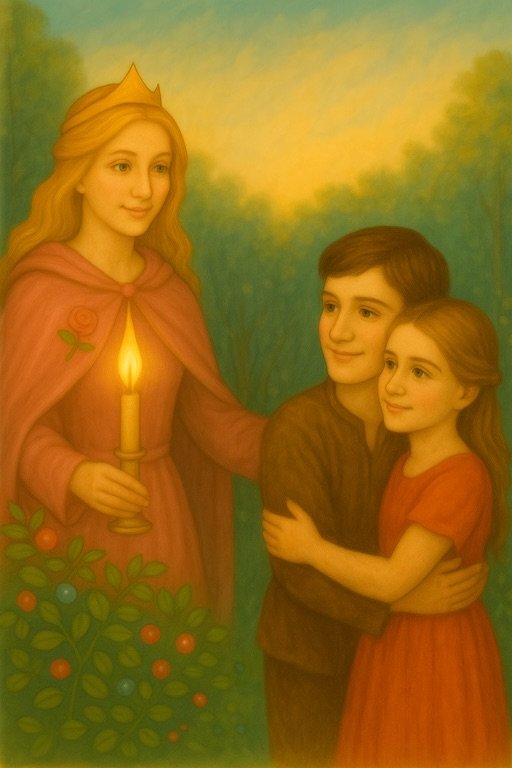
Symbol, Imagination and the Treasure Within
Why fairy tales still matter
Fairy tales survive because they speak a language older than explanation. They do not need to be realistic in order to be true. Their truth is symbolic, emotional and archetypal.
A forest, a locked door, a wounded child, a wise guide, a frightening monster, a hidden treasure: these images reach parts of us that ordinary advice often cannot touch. They allow the psyche to recognise itself without being cornered or lectured.
This is why fairy tales can be powerful companions in inner-child work. They are not therapy in themselves, and they should not be asked to replace therapeutic support where that is needed. But they can help create a symbolic space where feeling, memory and imagination can begin to move.
A fairy tale does not heal by explaining the wound. It offers the wounded part of us a story spacious enough to enter.
The inner child as a living image
The inner child is not a separate person hidden inside us. It is a way of describing the younger parts of the psyche that still carry wonder, creativity, vulnerability and unmet needs.
This child-part may appear when we feel joy, playfulness and delight. It may also appear when old hurt is touched, when we feel abandoned, ashamed, unseen or afraid. Adult life often asks us to function, but functioning is not the same as integration.
Fairy tales speak beautifully to this inner child because they do not shame vulnerability. They understand that small figures can be brave, that lost children can find help, and that dark places may contain hidden gifts.
The magic of symbolic storytelling
Symbolic stories let us approach difficult material indirectly. That matters. Some emotions are too complex to meet head-on, especially for children, and sometimes for adults too.
- The enchanted forest can represent confusion, transition or the unknown.
- The wise guide can represent intuition, the Higher Self or trustworthy support.
- The monster can represent fear, shadow or a defended part of the self.
- The treasure can represent a reclaimed gift, truth or capacity for love.
- The journey home can represent integration rather than a return to the past.
When we read these images, something inside us may say: I know this place. I know this fear. I know this longing. That recognition is often the beginning of healing.
A gentle Evolutionary Astrology perspective
Evolutionary Astrology and fairy tales share a respect for symbolic pattern. The birth chart is not a flat list of traits. It is a living field of archetypes, tensions and possibilities.
Pluto resembles the descent into the underworld and the confrontation with what has been buried. Chiron resembles the wound that becomes wiser through compassionate attention. Neptune resembles dream, longing, imagination and the unseen. The Nodes resemble the movement from familiar patterns toward new growth.
Fairy tales offer these same movements in story form. They remind us that transformation is rarely linear. We get lost, meet guides, face thresholds, encounter shadow and return with something that could not have been found by staying where we were.
The Sacred Garden as an inner-child story
In The Sacred Garden, the fairy-tale landscape becomes a map of inner return. Krystal invites trust in intuition. Francis honours curiosity, uncertainty and the need to question. Bella represents the Higher Self, the gentle guiding presence that helps the journey unfold. The Prince represents the Ego Shadow, the defended part of the self that is not to be destroyed, but understood and integrated.
The Garden Gate marks the threshold between ordinary awareness and symbolic awareness. To pass through it is to become willing to meet the inner world again.
For a child, this may simply feel magical. For an adult, it may feel like a reminder that the child within has not vanished. It may only be waiting for a story kind enough to call it forward.
How to work with fairy tales reflectively
- Read slowly and notice which image or character stays with you.
- Ask what feeling the story awakens rather than rushing to interpret it.
- Notice where the child in the story reminds you of yourself.
- Pay attention to the guide, helper or hidden resource in the tale.
- Let the story open a conversation; do not force it to produce an answer.
This kind of reading is not about analysing a story to death. It is about allowing the story to become a mirror. Sometimes the healing comes not from understanding everything, but from feeling that a forgotten part of us has been gently seen.
A gentle way to begin again
One of the kindest ways to work with the inner child is to begin without pressure. Choose a story that once mattered to you, or one that simply attracts you now. Read it not as an assignment, but as a meeting.
Notice where the body softens, where resistance appears, where emotion rises, or where an image stays in your mind after the book is closed. These responses do not have to be interpreted immediately. They can be respected as messages from a deeper layer of the self.
The aim is not to become childish. It is to recover the parts of innocence, imagination and trust that adult life may have pushed into hiding. Fairy tales give those parts a language gentle enough to approach.