A Children’s Book with a Message for Adults Too
A story that grows with the reader
The Sacred Garden is, first of all, a children’s story. It is meant to be read with warmth, wonder and the kind of gentle attention that belongs to bedtime, quiet afternoons and shared imagination.
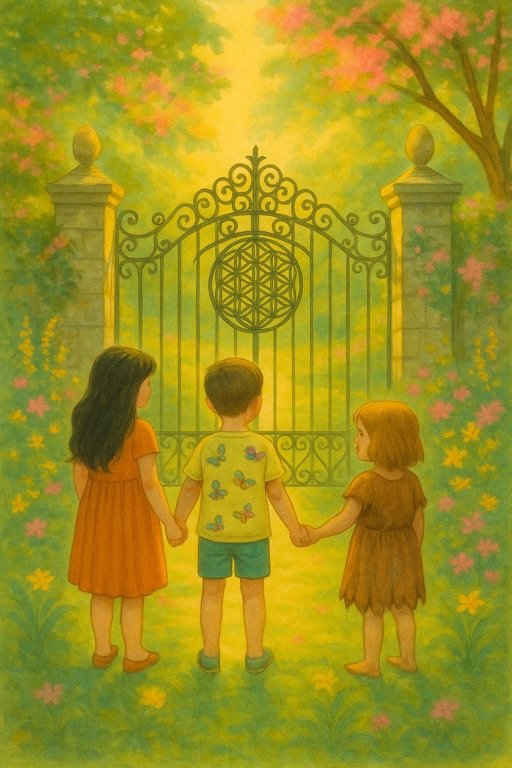
On the surface, it is a tale of two children, Krystal and Francis, who encounter a mysterious gate and find themselves drawn into a world of flowers, riddles, hidden pathways and unexpected companions. It is written simply enough for a child to enjoy, but symbolically enough for an adult to feel that something deeper is being stirred.
That is the quiet power of the old fairy-tale tradition. A child may follow the adventure. An adult may recognise the inner journey. The same story can speak to different layers of the soul at different times of life.
The best of these stories do not tell a child what to think; they leave room for the child to feel and notice for themselves.
What is The Sacred Garden really about?
The Sacred Garden is about innocence, courage and the gradual return to a deeper self. It is about the part of us that still knows how to wonder, and the part of us that becomes frightened, defended or lost along the way.
The garden is not only a magical location. It is an image of the inner world: the place where beauty, fear, memory and possibility meet. The gate marks a threshold. To cross it is to leave the purely ordinary world and enter the symbolic world, where every character and encounter carries meaning.
For children, this can feel like adventure. For adults, it may feel like recognition. Many of us spend years becoming responsible, practical and capable, but in the process we can lose contact with the softer, more intuitive parts of ourselves. A story like this gently asks whether those parts are truly gone, or simply waiting behind the gate.
The archetypes in the story
The characters in The Sacred Garden can be enjoyed simply as characters. They can also be read as archetypal figures within the psyche.
- Krystal carries the intuitive, receptive part of the child: the part that senses before it explains.
- Francis brings curiosity, questioning and the courage to keep exploring even when things are not immediately clear.
- Bella represents the Higher Self: the quiet, guiding presence that knows the way home without needing to dominate the journey.
- The Prince represents the Ego Shadow: not something evil to be destroyed, but a defended part of the self that needs to be seen, understood and integrated.
- The Garden itself represents the sacred inner space where lost parts of the self can be rediscovered.
This distinction matters. The story is not about rejecting the ego or pretending the shadow is not there. It is about bringing the defended, frightened or distorted parts of the self into relationship with a wiser inner presence. That is where healing becomes possible.
The Evolutionary Astrology beneath the surface
Evolutionary Astrology is not named directly in the story, and it does not need to be. The Sacred Garden is not a textbook disguised as a fairy tale. But the symbolic pattern of the book is deeply compatible with the evolutionary view of the soul.
Pluto is present in the descent into deeper truth, in the moments when a character must face what has been hidden. Neptune is present in the mist, the dream, the longing and the mystery. Chiron is present wherever tenderness, hurt and healing meet. Mars appears in the courage to continue. The Nodes are echoed in the sense of a path: one part familiar, another part calling the soul forward.
These are not literal correspondences that a child needs to analyse. They are symbolic resonances. They help explain why the story may feel simple and meaningful at the same time.
Why this story now?
We live in a noisy age. Children are often surrounded by speed, screens, performance and constant stimulation. Adults are often tired, distracted and trying to hold too much. In that kind of world, a gentle symbolic story can become a small sanctuary.
The Sacred Garden offers wonder without overwhelm. It offers spiritual depth without preaching. It gives children a story world they can enter with imagination, while giving adults a mirror for their own inner life.
It is not a book that tries to explain everything. It leaves room for feeling, intuition and conversation. That is part of its medicine.
Who is this book for?
- parents and grandparents looking for a meaningful story to share
- children who respond to beauty, mystery and gentle adventure
- adults who still feel the presence of the child they once were
- teachers, counsellors and reflective practitioners who value symbolic storytelling
- anyone drawn to stories where healing is suggested rather than forced
The Sacred Garden is not only for children because the inner child does not disappear when we grow older. It waits for the moment we are ready to listen again.
How to read it with a child
The Sacred Garden can be read simply, without explanation. A child does not need to know what an archetype is in order to feel the story. Often the best approach is to read slowly, notice what they notice, and let their questions lead the conversation.
- Ask which character they liked most, and why.
- Notice whether they are drawn to the gate, the garden, Bella, the Prince or the riddle.
- Let them imagine their own garden, flower, guide or hidden treasure.
- Avoid turning the story into a lesson. Let wonder do its quiet work.
For adults, the same approach applies. Rather than trying to decode every symbol immediately, allow the story to linger. The meaning may reveal itself differently each time it is read.
A gentle invitation
The Sacred Garden is a story to be entered rather than solved. It invites the child into wonder and the adult into remembrance.
Sometimes the gate we are looking for is not outside us. It is the moment we become willing to return to the sacred place within.
Step Through the Gate
Discover the story, the artwork and the deeper meaning behind The Sacred Garden.